 Unknown Artist - Agnes Frazee and Child 1834 (Probably Agnes Clark, Mrs Phineas Freeman Frazee Sr (1810-1891) of Brooklyn NY and then of Richland County, NJ, where he was a carriage maker. They had children in 1830, 1833, & 1834).
Monday, January 17, 2022
1834 Mother & Very Sweet Little Boy in Two Rather Amazing Hats
. Unknown Artist - Agnes Frazee and Child 1834 (Probably Agnes Clark, Mrs Phineas Freeman Frazee Sr (1810-1891) of Brooklyn NY and then of Richland County, NJ, where he was a carriage maker. They had children in 1830, 1833, & 1834).
Unknown Artist - Agnes Frazee and Child 1834 (Probably Agnes Clark, Mrs Phineas Freeman Frazee Sr (1810-1891) of Brooklyn NY and then of Richland County, NJ, where he was a carriage maker. They had children in 1830, 1833, & 1834).


Saturday, January 15, 2022
Well, One More Early 19th-Century American Boy & His Faithful Dog...
.
 Milton W. Hopkins (1789-1844) Pierrepont Edward Lacey (1832 - after 1860) and His Dog, Gun.
 Milton W. Hopkins (1789-1844) Pierrepont Edward Lacey (1832 - after 1860) and His Dog, Gun.
Thursday, January 13, 2022

Tuesday, January 11, 2022
Another 1830s Dog with a Couple of His Friends...
.
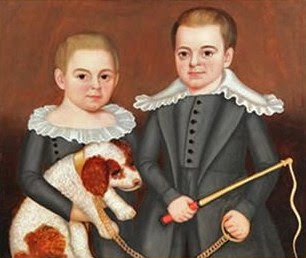 Milton W. Hopkins (1789-1844) Two Boys With Their Dog.
 Milton W. Hopkins (1789-1844) Two Boys With Their Dog.
Sunday, January 9, 2022
Simple Cap on Early 19th-Century Pennsylvania Moravian Single Sister
.
 Unknown Artist, Moravian Single Sister, ca. 1810-1820. Moravian Historical Society, Nazareth, PA
.
 Unknown Artist, Moravian Single Sister, ca. 1810-1820. Moravian Historical Society, Nazareth, PA
.
Friday, January 7, 2022

Wednesday, January 5, 2022
At School 1889
. Edward Lamson Henry (American Painter, 1841-1919) Kept In 1889
Edward Lamson Henry (1841–1919) was an American genre painter born in Charleston, South Carolina who came to live in New York at an early age. As a painter of early American life, he displays a quaint humour. Henry acquired an extensive collection of antiques, old photos, & assorted Americana, from which he researched his paintings. His wife Frances said that "Nothing annoyed him more than to see a wheel, a bit of architecture etc. carelessly drawn or out of keeping with the time it was supposed to portray.”
.
 Edward Lamson Henry (American Painter, 1841-1919) Kept In 1889
Edward Lamson Henry (1841–1919) was an American genre painter born in Charleston, South Carolina who came to live in New York at an early age. As a painter of early American life, he displays a quaint humour. Henry acquired an extensive collection of antiques, old photos, & assorted Americana, from which he researched his paintings. His wife Frances said that "Nothing annoyed him more than to see a wheel, a bit of architecture etc. carelessly drawn or out of keeping with the time it was supposed to portray.”
.
Monday, January 3, 2022
Talking with the Lawyer
.
 Edward Lamson Henry (American Painter, 1841-1919) A Country Lawyer 1895
Edward Lamson Henry (1841–1919) was an American genre painter born in Charleston, South Carolina who came to live in New York at an early age. As a painter of early American life, he displays a quaint humour. Henry acquired an extensive collection of antiques, old photos, & assorted Americana, from which he researched his paintings. His wife Frances said that "Nothing annoyed him more than to see a wheel, a bit of architecture etc. carelessly drawn or out of keeping with the time it was supposed to portray.”
.
 Edward Lamson Henry (American Painter, 1841-1919) A Country Lawyer 1895
Edward Lamson Henry (1841–1919) was an American genre painter born in Charleston, South Carolina who came to live in New York at an early age. As a painter of early American life, he displays a quaint humour. Henry acquired an extensive collection of antiques, old photos, & assorted Americana, from which he researched his paintings. His wife Frances said that "Nothing annoyed him more than to see a wheel, a bit of architecture etc. carelessly drawn or out of keeping with the time it was supposed to portray.”
.
Saturday, January 1, 2022
Putting Up Hay in Pennsylvania
. Edward Lamson Henry (American Painter, 1841-1919) Barnyard in Pennsylvania
Edward Lamson Henry (1841–1919) was an American genre painter born in Charleston, South Carolina who came to live in New York at an early age. As a painter of early American life, he displays a quaint humour. Henry acquired an extensive collection of antiques, old photos, & assorted Americana, from which he researched his paintings. His wife Frances said that "Nothing annoyed him more than to see a wheel, a bit of architecture etc. carelessly drawn or out of keeping with the time it was supposed to portray.”
.
 Edward Lamson Henry (American Painter, 1841-1919) Barnyard in Pennsylvania
Edward Lamson Henry (1841–1919) was an American genre painter born in Charleston, South Carolina who came to live in New York at an early age. As a painter of early American life, he displays a quaint humour. Henry acquired an extensive collection of antiques, old photos, & assorted Americana, from which he researched his paintings. His wife Frances said that "Nothing annoyed him more than to see a wheel, a bit of architecture etc. carelessly drawn or out of keeping with the time it was supposed to portray.”
.
Thursday, December 30, 2021
Come On In...
.
 Edward Lamson Henry (American Painter, 1841-1919) A Philadelphia Doorway 1882
Edward Lamson Henry (1841–1919) was an American genre painter born in Charleston, South Carolina who came to live in New York at an early age. As a painter of early American life, he displays a quaint humour. Henry acquired an extensive collection of antiques, old photos, & assorted Americana, from which he researched his paintings. His wife Frances said that "Nothing annoyed him more than to see a wheel, a bit of architecture etc. carelessly drawn or out of keeping with the time it was supposed to portray.”
.
 Edward Lamson Henry (American Painter, 1841-1919) A Philadelphia Doorway 1882
Edward Lamson Henry (1841–1919) was an American genre painter born in Charleston, South Carolina who came to live in New York at an early age. As a painter of early American life, he displays a quaint humour. Henry acquired an extensive collection of antiques, old photos, & assorted Americana, from which he researched his paintings. His wife Frances said that "Nothing annoyed him more than to see a wheel, a bit of architecture etc. carelessly drawn or out of keeping with the time it was supposed to portray.”
.
Tuesday, December 28, 2021
Visiting With Those Passing-By
.
 Edward Lamson Henry (American Painter, 1841-1919) An Informal Call 1895
Edward Lamson Henry (1841–1919) was an American genre painter born in Charleston, South Carolina who came to live in New York at an early age. As a painter of early American life, he displays a quaint humour. Henry acquired an extensive collection of antiques, old photos, & assorted Americana, from which he researched his paintings. His wife Frances said that "Nothing annoyed him more than to see a wheel, a bit of architecture etc. carelessly drawn or out of keeping with the time it was supposed to portray.”
.
 Edward Lamson Henry (American Painter, 1841-1919) An Informal Call 1895
Edward Lamson Henry (1841–1919) was an American genre painter born in Charleston, South Carolina who came to live in New York at an early age. As a painter of early American life, he displays a quaint humour. Henry acquired an extensive collection of antiques, old photos, & assorted Americana, from which he researched his paintings. His wife Frances said that "Nothing annoyed him more than to see a wheel, a bit of architecture etc. carelessly drawn or out of keeping with the time it was supposed to portray.”
.
Sunday, December 26, 2021
Reading at Home
.
 Edward Lamson Henry (American Painter, 1841-1919) At Home with a Good Book 1872
Edward Lamson Henry (1841–1919) was an American genre painter born in Charleston, South Carolina who came to live in New York at an early age. As a painter of early American life, he displays a quaint humour. Henry acquired an extensive collection of antiques, old photos, & assorted Americana, from which he researched his paintings. His wife Frances said that "Nothing annoyed him more than to see a wheel, a bit of architecture etc. carelessly drawn or out of keeping with the time it was supposed to portray.”
.
 Edward Lamson Henry (American Painter, 1841-1919) At Home with a Good Book 1872
Edward Lamson Henry (1841–1919) was an American genre painter born in Charleston, South Carolina who came to live in New York at an early age. As a painter of early American life, he displays a quaint humour. Henry acquired an extensive collection of antiques, old photos, & assorted Americana, from which he researched his paintings. His wife Frances said that "Nothing annoyed him more than to see a wheel, a bit of architecture etc. carelessly drawn or out of keeping with the time it was supposed to portray.”
.
Friday, December 24, 2021
Watering the Horse
.
 Edward Lamson Henry (American Painter, 1841-1919) At the Watering Trough 1899
Edward Lamson Henry (1841–1919) was an American genre painter born in Charleston, South Carolina who came to live in New York at an early age. As a painter of early American life, he displays a quaint humour. Henry acquired an extensive collection of antiques, old photos, & assorted Americana, from which he researched his paintings. His wife Frances said that "Nothing annoyed him more than to see a wheel, a bit of architecture etc. carelessly drawn or out of keeping with the time it was supposed to portray.”
.
 Edward Lamson Henry (American Painter, 1841-1919) At the Watering Trough 1899
Edward Lamson Henry (1841–1919) was an American genre painter born in Charleston, South Carolina who came to live in New York at an early age. As a painter of early American life, he displays a quaint humour. Henry acquired an extensive collection of antiques, old photos, & assorted Americana, from which he researched his paintings. His wife Frances said that "Nothing annoyed him more than to see a wheel, a bit of architecture etc. carelessly drawn or out of keeping with the time it was supposed to portray.”
.
Wednesday, December 22, 2021
Riding in the Carriage
'
 Edward Lamson Henry (American Painter, 1841-1919) Carriage Ride 1886
Edward Lamson Henry (1841–1919) was an American genre painter born in Charleston, South Carolina who came to live in New York at an early age. As a painter of early American life, he displays a quaint humour. Henry acquired an extensive collection of antiques, old photos, & assorted Americana, from which he researched his paintings. His wife Frances said that "Nothing annoyed him more than to see a wheel, a bit of architecture etc. carelessly drawn or out of keeping with the time it was supposed to portray.”
.
 Edward Lamson Henry (American Painter, 1841-1919) Carriage Ride 1886
Edward Lamson Henry (1841–1919) was an American genre painter born in Charleston, South Carolina who came to live in New York at an early age. As a painter of early American life, he displays a quaint humour. Henry acquired an extensive collection of antiques, old photos, & assorted Americana, from which he researched his paintings. His wife Frances said that "Nothing annoyed him more than to see a wheel, a bit of architecture etc. carelessly drawn or out of keeping with the time it was supposed to portray.”
.
Monday, December 20, 2021
Children Resting 1879
.
 Edward Lamson Henry (American Painter, 1841-1919) Childhood 1879
Edward Lamson Henry (1841–1919) was an American genre painter born in Charleston, South Carolina who came to live in New York at an early age. As a painter of early American life, he displays a quaint humour. Henry acquired an extensive collection of antiques, old photos, & assorted Americana, from which he researched his paintings. His wife Frances said that "Nothing annoyed him more than to see a wheel, a bit of architecture etc. carelessly drawn or out of keeping with the time it was supposed to portray.”
.
 Edward Lamson Henry (American Painter, 1841-1919) Childhood 1879
Edward Lamson Henry (1841–1919) was an American genre painter born in Charleston, South Carolina who came to live in New York at an early age. As a painter of early American life, he displays a quaint humour. Henry acquired an extensive collection of antiques, old photos, & assorted Americana, from which he researched his paintings. His wife Frances said that "Nothing annoyed him more than to see a wheel, a bit of architecture etc. carelessly drawn or out of keeping with the time it was supposed to portray.”
.
Saturday, December 18, 2021
Coming Home
. Edward Lamson Henry (American Painter, 1841-1919) Coming Home
Edward Lamson Henry (1841–1919) was an American genre painter born in Charleston, South Carolina who came to live in New York at an early age. As a painter of early American life, he displays a quaint humour. Henry acquired an extensive collection of antiques, old photos, & assorted Americana, from which he researched his paintings. His wife Frances said that "Nothing annoyed him more than to see a wheel, a bit of architecture etc. carelessly drawn or out of keeping with the time it was supposed to portray.”
.
 Edward Lamson Henry (American Painter, 1841-1919) Coming Home
Edward Lamson Henry (1841–1919) was an American genre painter born in Charleston, South Carolina who came to live in New York at an early age. As a painter of early American life, he displays a quaint humour. Henry acquired an extensive collection of antiques, old photos, & assorted Americana, from which he researched his paintings. His wife Frances said that "Nothing annoyed him more than to see a wheel, a bit of architecture etc. carelessly drawn or out of keeping with the time it was supposed to portray.”
.
Thursday, December 16, 2021
Waiting for the Ferry
. Edward Lamson Henry (American Painter, 1841-1919) Waiting for the Ferry
Edward Lamson Henry (1841–1919) was an American genre painter born in Charleston, South Carolina who came to live in New York at an early age. As a painter of early American life, he displays a quaint humour. Henry acquired an extensive collection of antiques, old photos, & assorted Americana, from which he researched his paintings. His wife Frances said that "Nothing annoyed him more than to see a wheel, a bit of architecture etc. carelessly drawn or out of keeping with the time it was supposed to portray.”
.
 Edward Lamson Henry (American Painter, 1841-1919) Waiting for the Ferry
Edward Lamson Henry (1841–1919) was an American genre painter born in Charleston, South Carolina who came to live in New York at an early age. As a painter of early American life, he displays a quaint humour. Henry acquired an extensive collection of antiques, old photos, & assorted Americana, from which he researched his paintings. His wife Frances said that "Nothing annoyed him more than to see a wheel, a bit of architecture etc. carelessly drawn or out of keeping with the time it was supposed to portray.”
.
Wednesday, December 8, 2021
Sitting in the Parlor
.
 Edward Lamson Henry (American Painter, 1841-1919) Parlor on Brooklyn Heights of Mr and Mrs John Ballard 1872
Edward Lamson Henry (1841–1919) was an American genre painter born in Charleston, South Carolina who came to live in New York at an early age. As a painter of early American life, he displays a quaint humour. Henry acquired an extensive collection of antiques, old photos, & assorted Americana, from which he researched his paintings. His wife Frances said that "Nothing annoyed him more than to see a wheel, a bit of architecture etc. carelessly drawn or out of keeping with the time it was supposed to portray.”
.
 Edward Lamson Henry (American Painter, 1841-1919) Parlor on Brooklyn Heights of Mr and Mrs John Ballard 1872
Edward Lamson Henry (1841–1919) was an American genre painter born in Charleston, South Carolina who came to live in New York at an early age. As a painter of early American life, he displays a quaint humour. Henry acquired an extensive collection of antiques, old photos, & assorted Americana, from which he researched his paintings. His wife Frances said that "Nothing annoyed him more than to see a wheel, a bit of architecture etc. carelessly drawn or out of keeping with the time it was supposed to portray.”
.
Monday, December 6, 2021
Paintings of Women by John Vanderlyn (American Neoclassical Painter, 1775-1852)
. John Vanderlyn (American Neoclassical Painter, 1775-1852) Mary Scott Swan 1815
 John Vanderlyn (American Neoclassical Painter, 1775-1852) Sarah Russell Church 1800
 John Vanderlyn (American Neoclassical Painter, 1775-1852) Theodosia Burr
Theodosia Burr Alston was the daughter of Aaron Burr. She was educated at home by her father & was able to write fluently in Greek & Latin, as well as French & English. Aaron Burr was ahead of his time in believing that a young woman should be given the opportunity to receive the same education as a man.
When Theodosia was 17 years old, & her father was about to become Vice President under Thomas Jefferson, (both had received the same number of votes in the electoral college while running for president), Theodosia married Joseph Alston, the governor of South Carolina. They honeymooned at Niagra Falls, the first known American couple to do so. Their son, Aaron Burr Alston ("Gampy"), was born in the following year.
 John Vanderlyn (American Neoclassical Painter, 1775-1852) Mother and Son 1800
 John Vanderlyn (American Neoclassical Painter, 1775-1852) Mrs Marinus Willett and Her Son Marinus Jr 1802
 John Vanderlyn (American Neoclassical Painter, 1775-1852) Elizabeth Maria Church 1799
 John Vanderlyn (American Neoclassical Painter, 1775-1852) Theodosia Burr Alston
 John Vanderlyn (American Neoclassical Painter, 1775-1852) Mary Ellis Bell (Mrs Isaac Bell) 1827
 John Vanderlyn (American Neoclassical Painter, 1775-1852) Mrs. Daniel Strobel, Jr. (Anna Church Strobel) and Her Son George, ca. 1799
John Vanderlyn (American Neoclassical Painter, 1775-1852) was born at Kingston, New York. He was employed by a print-seller in New York, and was first instructed in art by Archibald Robinson (1765–1835), a Scotsman who was afterwards one of the directors of the American Academy of the Fine Arts. He went to Philadelphia, where he spent time in the studio of Gilbert Stuart and copied some of Stuart's portraits, including one of Aaron Burr, who placed him under Gilbert Stuart as a pupil.
In 1796, Aaron Burr sent Vanderlyn to Paris, where he studied for 5 years. He returned to the United States in 1801 and lived in the home of Burr, then the Vice President, where he painted the well-known likeness of Burr and his daughter.
 John Vanderlyn (American Neoclassical Painter, 1775-1852) Self Portrait.
 John Vanderlyn (American Neoclassical Painter, 1775-1852) Mary Scott Swan 1815
 John Vanderlyn (American Neoclassical Painter, 1775-1852) Sarah Russell Church 1800
 John Vanderlyn (American Neoclassical Painter, 1775-1852) Theodosia Burr
Theodosia Burr Alston was the daughter of Aaron Burr. She was educated at home by her father & was able to write fluently in Greek & Latin, as well as French & English. Aaron Burr was ahead of his time in believing that a young woman should be given the opportunity to receive the same education as a man.
When Theodosia was 17 years old, & her father was about to become Vice President under Thomas Jefferson, (both had received the same number of votes in the electoral college while running for president), Theodosia married Joseph Alston, the governor of South Carolina. They honeymooned at Niagra Falls, the first known American couple to do so. Their son, Aaron Burr Alston ("Gampy"), was born in the following year.
 John Vanderlyn (American Neoclassical Painter, 1775-1852) Mother and Son 1800
 John Vanderlyn (American Neoclassical Painter, 1775-1852) Mrs Marinus Willett and Her Son Marinus Jr 1802
 John Vanderlyn (American Neoclassical Painter, 1775-1852) Elizabeth Maria Church 1799
 John Vanderlyn (American Neoclassical Painter, 1775-1852) Theodosia Burr Alston
 John Vanderlyn (American Neoclassical Painter, 1775-1852) Mary Ellis Bell (Mrs Isaac Bell) 1827
 John Vanderlyn (American Neoclassical Painter, 1775-1852) Mrs. Daniel Strobel, Jr. (Anna Church Strobel) and Her Son George, ca. 1799
John Vanderlyn (American Neoclassical Painter, 1775-1852) was born at Kingston, New York. He was employed by a print-seller in New York, and was first instructed in art by Archibald Robinson (1765–1835), a Scotsman who was afterwards one of the directors of the American Academy of the Fine Arts. He went to Philadelphia, where he spent time in the studio of Gilbert Stuart and copied some of Stuart's portraits, including one of Aaron Burr, who placed him under Gilbert Stuart as a pupil.
In 1796, Aaron Burr sent Vanderlyn to Paris, where he studied for 5 years. He returned to the United States in 1801 and lived in the home of Burr, then the Vice President, where he painted the well-known likeness of Burr and his daughter.
 John Vanderlyn (American Neoclassical Painter, 1775-1852) Self Portrait.
Thursday, December 2, 2021
Etiquette for American Ladies 1840 - Consent for an Introduction

Etiquette for Ladies: With Hints on the Preservation, Improvement, and Display of Female Beauty. Published by Lea and Blanchard, Philadelphia. 1838-1840
In the introduction of one gentleman to another, great prudence and caution must be used by the really polite man; but in the introduction of ladies to each other, and to gentlemen, infinitely more care is necessary, as a lady cannot shake off an improper acquaintance with the same facility as a gentleman can do, and their character is much easier affected by apparent contact with the worthless and the dissipated.
It is incumbent, therefore, on ladies to avoid all proffers of introductions, unless from those on whom, from relationship or other causes, they can place the most implicit confidence.
As a general rule, ladies may always at once accord to any offers of introduction that may proceed from a father, mother, husband, sister, or brother; those from intimate cousins and tried friends are also to be considered favourably, although not to be entitled to the same implicit reliance as the former.
No person of correct feeling will make an introduction to a lady, without having first apprized her of it, and obtained her consent.
.
Tuesday, November 30, 2021
Fashion for the Privileged 1809
.
Evening Full Dress
Title: Ackerman's Repository
Item Date: January, 1809
Collection: Casey Fashion Plates
Location: Los Angeles Public Library
.

Evening Full Dress
Title: Ackerman's Repository
Item Date: January, 1809
Collection: Casey Fashion Plates
Location: Los Angeles Public Library
.
Sunday, November 28, 2021
Etiquette for American Ladies 1840 - The Curtsey upon an Introduction
Etiquette for Ladies: With Hints on the Preservation, Improvement, and Display of Female Beauty. Published by Lea and Blanchard, Philadelphia. 1838-1840
Formerly it was the habit for the ladies to curtsey on being introduced, but this has latterly been changed into the more easy and graceful custom of bowing.
The habit of saluting and shaking hands is now quite obsolete, except in some country towns where ladies at first introductions salute other ladies by kissing them on the cheek, and fervently shake the hands of the gentlemen.
At present, in the best society, all that a lady is called upon to do, upon a first introduction either to a lady or a gentleman, is to make a slight, but gracious inclination of the head.
Upon one lady meeting another for the second or subsequent times, the hand may be extended in supplement to the inclination of the head; but no lady should ever extend her hand to a gentleman, unless she is very intimate,—a bow at meeting, and one at parting, is all that is necessary.
Ladies should never bow hastily, but with slow and measured dignity.
.
Friday, November 26, 2021
Fashion for the Privileged 1809
.
Dancing Dress
Title: Ackerman's Repository
Item Date: February, 1809
Collection: Casey Fashion Plates
Location: Los Angeles Public Library
.

Dancing Dress
Title: Ackerman's Repository
Item Date: February, 1809
Collection: Casey Fashion Plates
Location: Los Angeles Public Library
.
Wednesday, November 24, 2021
Etiquette for American Ladies 1840 - Avoiding an Introduced Gentleman
Etiquette for Ladies: With Hints on the Preservation, Improvement, and Display of Female Beauty. Published by Lea and Blanchard, Philadelphia. 1838-1840
If you wish to avoid the company of any one that has been properly introduced, satisfy your own mind that your reasons are correct; and then let no inducement cause you to shrink from treating him with respect, at the same time shunning his company. No gentleman will thus be able either to blame or mistake you.
If, in travelling, any one introduces himself to you, and does it in a proper and respectful manner, conduct yourself towards him with politeness, ease, and dignity; if he is a gentleman, he will appreciate your behaviour—and if not a gentleman will be deterred from annoying you; but acquaintanceships thus formed must cease where they began, and your entering into conversation with a lady or gentleman in a boat or a coach does not give any of you a right to after recognition.
If any one introduces himself to you in a manner betraying the least want of respect, either towards you or himself, you can only turn from him in dignified silence,—and if he presumes to address you further, then there is no punishment too severe.
.
Monday, November 22, 2021
American Women & Children by the Beardsley Limner (active between 1785-1805)
.
 The Beardsley Limner (American painter, active 1785-1805 possibly Sarah Bushnell Perkins 1771-1831) Boy with Dog
 The Beardsley Limner (American painter, active 1785-1805 possibly Sarah Bushnell Perkins 1771-1831) Harmony Child Mrs Oliver Wright
The Beardsley Limner, an American painter active 1785-1805, was an itinerant artist who executed several naive portraits along the old Boston Post Road, in Connecticut & Massachusetts, from about 1785 to 1805. This name is derived from portraits this artist made of Elizabeth & Hezekiah Beardsley. The Beardsley Limner may actually be a Connecticut pastelist Sarah Perkins. Some stylistic similarities exist between the two, but there are sufficient differences to raise questions about a definitive identification. Works shown here are attributed to the Beardsley Limner.
 The Beardsley Limner (American painter, active 1785-1805 possibly Sarah Bushnell Perkins 1771-1831)
 The Beardsley Limner (American painter, active 1785-1805 possibly Sarah Bushnell Perkins 1771-1831) Elizabeth Davis Mrs Hezekiah Beardsley 1789
 The Beardsley Limner (American painter, active 1785-1805 possibly Sarah Bushnell Perkins 1771-1831) Child Posing with Cat 1790s
 The Beardsley Limner (American painter, active 1785-1805 possibly Sarah Bushnell Perkins 1771-1831) Boy in a Windsor Chair
 The Beardsley Limner (American painter, active 1785-1805 possibly Sarah Bushnell Perkins 1771-1831) Girl In a Pink Dress 1790
 The Beardsley Limner (American painter, active 1785-1805 possibly Sarah Bushnell Perkins 1771-1831)
 The Beardsley Limner (American painter, active 1785-1805 possibly Sarah Bushnell Perkins 1771-1831) Charles Adams Wheeler, c. 1790
 The Beardsley Limner (American painter, active 1785-1805 possibly Sarah Bushnell Perkins 1771-1831) Girl in Lace Cap 1790s
.
 The Beardsley Limner (American painter, active 1785-1805 possibly Sarah Bushnell Perkins 1771-1831) Boy with Dog
 The Beardsley Limner (American painter, active 1785-1805 possibly Sarah Bushnell Perkins 1771-1831) Harmony Child Mrs Oliver Wright
The Beardsley Limner, an American painter active 1785-1805, was an itinerant artist who executed several naive portraits along the old Boston Post Road, in Connecticut & Massachusetts, from about 1785 to 1805. This name is derived from portraits this artist made of Elizabeth & Hezekiah Beardsley. The Beardsley Limner may actually be a Connecticut pastelist Sarah Perkins. Some stylistic similarities exist between the two, but there are sufficient differences to raise questions about a definitive identification. Works shown here are attributed to the Beardsley Limner.
 The Beardsley Limner (American painter, active 1785-1805 possibly Sarah Bushnell Perkins 1771-1831)
 The Beardsley Limner (American painter, active 1785-1805 possibly Sarah Bushnell Perkins 1771-1831) Elizabeth Davis Mrs Hezekiah Beardsley 1789
 The Beardsley Limner (American painter, active 1785-1805 possibly Sarah Bushnell Perkins 1771-1831) Child Posing with Cat 1790s
 The Beardsley Limner (American painter, active 1785-1805 possibly Sarah Bushnell Perkins 1771-1831) Boy in a Windsor Chair
 The Beardsley Limner (American painter, active 1785-1805 possibly Sarah Bushnell Perkins 1771-1831) Girl In a Pink Dress 1790
 The Beardsley Limner (American painter, active 1785-1805 possibly Sarah Bushnell Perkins 1771-1831)
 The Beardsley Limner (American painter, active 1785-1805 possibly Sarah Bushnell Perkins 1771-1831) Charles Adams Wheeler, c. 1790
 The Beardsley Limner (American painter, active 1785-1805 possibly Sarah Bushnell Perkins 1771-1831) Girl in Lace Cap 1790s
.
Sunday, November 21, 2021
Poet Emily Dickinson (1830-1886) at the New York Botanical Garden in the Bronx

My nosegays are for Captives
Dim – long expectant eyes –
Fingers denied the plucking,
Patient till Paradise –
To such, if they sh'd whisper
Of morning and the moor –
They bear no other errand,
And I, no other prayer.
 Emily Dickinson (1830-1886) was a reclusive American poet. Unrecognized in her own time, Dickinson is known posthumously for her innovative use of form and syntax.
Dim – long expectant eyes –
Fingers denied the plucking,
Patient till Paradise –
To such, if they sh'd whisper
Of morning and the moor –
They bear no other errand,
And I, no other prayer.
Emily Dickinson (1830-1886) was a reclusive American poet. Unrecognized in her own time, Dickinson is known posthumously for her innovative use of form and syntax.The New York Botanical Garden's library produced an exhibit, “Emily Dickinson’s Garden: The Poetry of Flowers." An exhibition of over 50 books, manuscripts, watercolors, & photographs retold the story of Emily Dickinson’s life including her reclusiveness, her adoration of flowers & plants, and her reluctance to share her poetry.
 Links between her verse & the plants & flowers provided inspiration for her poems on display along with original manuscripts. Most importantly it also included an interactive exhibit of Emily's own herbarium of over 400 plants, now in the online collection of the Houghton Library, Harvard University.
Dickinson studied botany from the age of 9 & throughout her life tended the garden at the Homestead, the family's home. She sent homegrown bouquets to friends, studied botany at Amherst Academy, & tended her own glassed conservatory off her father's study. As an amateur botanist, she collected, pressed, classified, & labeled more than 400 flower specimens.
 A reproduction of her only existing dress (she reportedly wore only white later in life) is on loan from the Emily Dickinson Museum in Amherst.

A reproduction of her only existing dress (she reportedly wore only white later in life) is on loan from the Emily Dickinson Museum in Amherst.The exhibit also included what must be a guess at a recreation of Emily's garden. No historical documents about her actual garden seem to exist, only her herbarium, letters, & poems referring to plants. Over a third of Dickinson's poems & nearly half of her letters allude with passionate intensity to her favorite wildflowers, to traditional blooms like the daisy or gentian, & to the exotic gardenias & jasmines of her conservatory.
 The exhibition catalog featureed essays by Dickinson authors Judith Farr & Marta McDowell. McDowell wrote Emily Dickinson's Gardens: A Celebration of a Poet and Gardener, & Farr wrote The Gardens of Emily Dickinson.
 It is clear to those who read this blog, that Emily Dickinson is one of my favorite poets. I wrote my undergrad senior honors paper on her work in college.

The exhibition catalog featureed essays by Dickinson authors Judith Farr & Marta McDowell. McDowell wrote Emily Dickinson's Gardens: A Celebration of a Poet and Gardener, & Farr wrote The Gardens of Emily Dickinson.It is clear to those who read this blog, that Emily Dickinson is one of my favorite poets. I wrote my undergrad senior honors paper on her work in college.
Subscribe to:
Posts (Atom)