Saturday, August 31, 2019

Women on the North American Canadian Frontier in 19C - by Dutch-born Cornelius Krieghoff 1815-1872


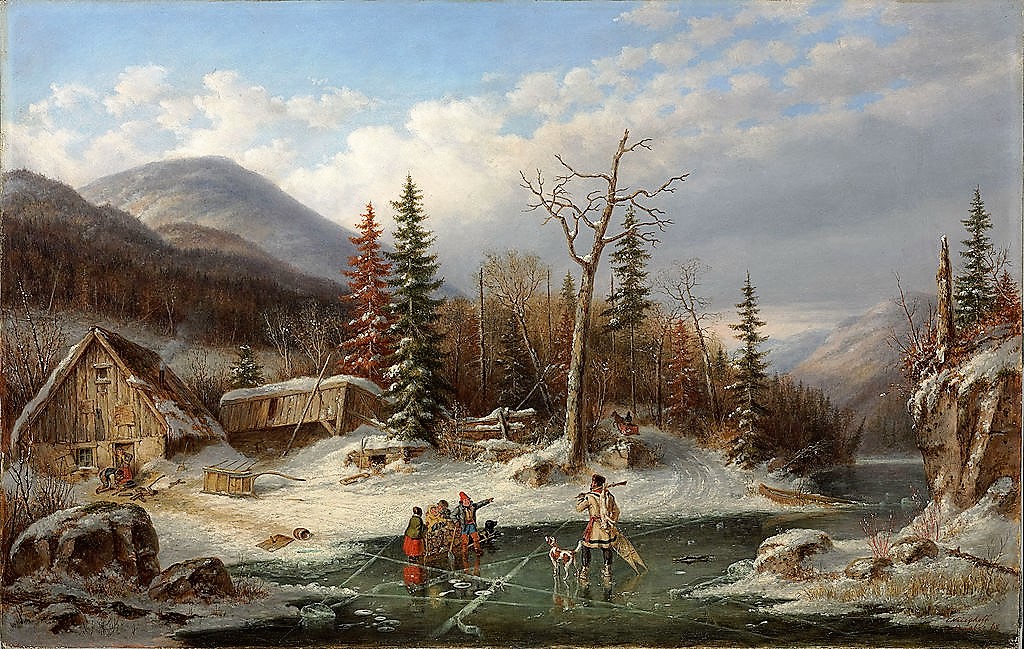
Cornelius Krieghoff was born in Amsterdam, spent his formative years in Bavaria, and studied in Rotterdam & Dusseldorf. He traveled to the United States in the 1830s, where he served in the Army for a few years. He married a young woman from Quebec and moved to the Montreal area, where he created genre paintings of the people & countryside of Canada. According to Charles C. Hill, "Krieghoff was the first Canadian artist to interpret in oils... the splendour of our waterfalls, and the hardships and daily life of people living on the edge of new frontiers" Krieghoff lived in Quebec from 1854-1863, before he came to Chicago to live with his daughter.

Cornelius Krieghoff (Dutch-born Canadian painter, 1815-1872) Settler's House


Thursday, August 29, 2019

Moving West - Domestic Chores - 1824-27 in Missouri


In 1803, President Thomas Jefferson quietly purchased the territory of Louisiana from the French government for $15 million. The Louisiana Purchase stretched from the Mississippi River to the Rocky Mountains and from Canada to New Orleans, & it doubled the size of the United States. To Jefferson, westward expansion was the key to the nation’s moral health. He believed that a republic depended on an independent, virtuous citizenry for its survival, & that independence & virtue went hand in hand with land ownership, especially the ownership of small farms. “Those who labor in the earth,” he wrote, “are the chosen people of God.”

Gottfried Duden, Report on a Journey to the Western States of North America: Written during a stay of several years along the Missouri, 1824-1827.


A woman on the Montana frontier in the 19C. Photo by Evelyn Jephson Cameron (This photo is decades later than the narrative; but it is by a female photographer, and I just couldn't resist.)

ST. LOUIS, MISSOURI. October 26, 1824. Domestic chores for women on the frontier

"The choicest settlements are along the Ohio, the White, and the Wabash rivers. The state was established in 1816 and, at present, has a population of about a hundred and fifty thousand souls. Slavery is as little permissible as in the state of Ohio and in Illinois. It is claimed that this law is not favorable to the rapid progress of the interior.

"The state of Ohio has been able to increase its population more easily through the immigration of poor settlers from the Atlantic states. Settlements in the more remote regions, however, require more means, which are almost exclusively in the possession of such persons who, because of their education and their circumstances, are relieved from spending all their time in physical labor, and usually make use of servants or slaves in establishing settlements.

"As long as the population is sparse, servants are very expensive. I have stayed overnight in houses that were very luxurious in their accoutrements, with costly carpets in all rooms, but one asked in vain for a servant. The landlord was compelled, in spite of his considerable wealth, to care personally for the horses as well as for the guests.

"Furthermore, his wife and daughters had to perform the most menial household tasks. Their only topic of conversation was that they wished to sell their establishments in order to move to a state where one could keep slaves."
.

Tuesday, August 27, 2019

Women on the North American Canadian Frontier in 19C - by Dutch-born Cornelius Krieghoff 1815-1872


Cornelius Krieghoff was born in Amsterdam, spent his formative years in Bavaria, and studied in Rotterdam & Dusseldorf. He traveled to the United States in the 1830s, where he served in the Army for a few years. He married a young woman from Quebec and moved to the Montreal area, where he created genre paintings of the people & countryside of Canada. According to Charles C. Hill, "Krieghoff was the first Canadian artist to interpret in oils... the splendour of our waterfalls, and the hardships and daily life of people living on the edge of new frontiers" Krieghoff lived in Quebec from 1854-1863, before he came to Chicago to live with his daughter.

Cornelius Krieghoff (Dutch-born Canadian painter, 1815-1872) Winter Landscape 1849


Sunday, August 25, 2019

19C Southern Emancipated Slave Woman by William Aiken Walker 1839-1921

Freed Female Slave by William Aiken Walker (American genre artist, 1839-1921 best known for depicting poor black emancipated slaves in the post-Reconstruction American South.) 

Friday, August 23, 2019

1st Black Woman in US Postal Service


This former slave was the 1st black woman delivering letters & packages in America's Old West.  

Mary Fields, born in 1832, in Hickman County, Tennessee, was born a slave, grew up an orphan, never married or had children. She was owned by Dr. Elijah Dunn & grew up on his family farm, where she became close with his daughter, Dolly, who was about Mary's age. Unlike most slaves, Mary learned to read & write. After emancipation, Mary stayed with the Dunns for a while, before traveling up the Mississippi & Ohio rivers towards Toledo.

When Mary was in her 30s, she received a letter from her childhood friend Dolly Dunn, who had become an Ursuline nun, known as Sister Amadeus. Mary eagerly accepted her friend’s request to join her at the Ursuline convent in Toledo, Ohio. Soon after Mary’s arrival, however, Sister Amadeus was assigned to head west to become the headmistress of a school for Native American girls in Montana. Mary did not to accompany the nuns; but when she learned that Sister Amadeus was ill with pneumonia, Mary also headed to Montana. Feisty Mary Fields lived by her wits & her strength. She was 6' tall & weighed over 200 pounds.

After nursing her childhood friend, now Mother Amadeus back to health, she decided to stay & help build St. Peter's mission school & protect the nuns. The nuns hired Mary to do heavy work & to haul freight and food supplies. She chopped wood, did stone work, carpentry, & dug privies. Mary was a two-fisted, hard-drinking woman, who needed nobody to fight her battles for her. She smoked homemade cigars & carried a six-shooter plus a shotgun.

When the nuns arrived, the mission school consisted of old buildings that were badly in need of repair. Mary soon became the foreman of the other workers at the school. There was one man, however, who did not want to take orders from a black woman, or from any woman. He argued with Mary, & then struck her. While Mary was falling, the man reached for his gun. Mary, in self-defense, snatched her six-shooter & fired. When the bishop in charge of the school heard about the gunfight, he demanded that Mary be fired. Sister Amadeus could not bear to let her friend go under such circumstances. The nuns at St. Peter's Catholic Mission near Cascade, Montana, had became her family.

When forced to leave the mission because of her behavior, the nuns financed a business, so Mary could support herself. She opened a cafe. Mary's big heart & poor cooking skills drove her business into the ground rather quickly. She consistently fed hungry indigents, but most paying customers among the townsfolk did not frequent the little restaurant.

But Mary needed to support herself, so in 1895, when Mary heard that the United States Postal Service was looking for someone to deliver mail from the town of Cascade, Montana, to families in the surrounding areas, she applied for the job. Even though she was about 60 years old at the time, Mary proved herself the fastest applicant to hitch a team of six horses & was hired. Thus, Mary became the 2nd woman & the 1st African American woman to work for the United States Post Office Department.

Since she had always been independent & determined, this work was perfect for her. She quickly she developed a reputation for delivering letters & parcels no matter what the weather, nor how rugged the terrain. She & her mule, Moses, plunged through anything, from raw blizzards to wilting heat, reaching remote miner's cabins & other outposts. In the winter, heavy snowfalls plunged the trails under drifts. On several occasions, Mary’s mule could not cross the drifts. Determined to do her job, she walked alone to deliver the mail. Once she walked 10 miles back to the depot.

Mary continued to deliver the mail until she was almost 70 years old, earning the nickname of “Stagecoach Mary.” When she decided to retire in 1901, the nuns at the mission helped her open a laundry service in Cascade. A laundry business, however, was not enough to keep Mary busy; & she spent much time caring for her garden. She would carry bouquets of flowers from her garden to the local baseball team; & her birthdays developed into a town-wide celebration each year, until she died in 1914.

Wednesday, August 21, 2019

1830 Odd Scraps of Information for the Frugal Housewife

Lydia Maria Francis Child
The Frugal Housewife - Dedicated to Those Who Are Not Ashamed of Economy 2nd Edition To Which is Added Hints to Persons of Moderate Fortune
Boston: Carter and Hendee. 1830
Henry Mosler (American genre artist, 1841-1920)  Just Moved

ODD SCRAPS FOR THE ECONOMY-MINDED

IF you would avoid waste in your family, attend to the following rules, and do not despise them because they appear so unimportant: 'many a little makes a mickle.'

Look frequently to the pails, to see that nothing is thrown to the pigs, which should have been in the grease-pot.


Look to the grease-pot, and see that nothing is there which might have served to nourish your own family, or a poorer one.


See that the beef and pork are always under brine; and that the brine is sweet and clean.


Count towels, sheets, spoons, &c., occasionally; that those who use them may not become careless.


See that the vegetables are neither sprouting, nor decaying; if they are so, remove them to a drier place and spread them.


Examine preserves, to see that they are not contracting mould; and your pickles, to see that they are not growing soft and tasteless.


As far as it is possible, have bits of bread eaten up before they become hard. Spread those that are not eaten, and let them dry to be pounded for puddings, or soaked for brewis. Brewis is made of crusts, and dry pieces of bread, soaked a good while in hot milk, mashed up, and salted and buttered like toast. Above all, do not let them accumulate in such quantities that they cannot be used. With proper care, there is no need of losing a particle of bread, even in the hottest weather.


Attend to all the mending in the house, once a week, if possible. Never put out sewing. If it be impossible to do it in your own family, hire some one into the house, and work with them.


Make your own bread and cake. Some people think it is just as cheap to buy of the baker and confectioner; but it is not half as cheap. True, it is more convenient; and therefore the rich are justifiable in employing them; but those who are under the necessity of being economical, should make convenience a secondary object. In the first place, confectioners make their cake richer than people of moderate income can afford to make it; in the next place, your domestic, or yourself, may just as well employ your own time, as to pay them for theirs.


When ivory-handled knives turn yellow, rub them with nice sand paper, or emery; it will take off the spots and restore their whiteness.


When a carpet is faded, I have been told that it may be restored, in a great measure, (provided there be no grease in it) by being dipped into strong salt and water. I never tried this; but I know that

silk pocket-handkerchiefs, and deep blue factory cotton, will not fade, if dipped in salt and water, while new.

An ox's gall will set any color,--silk, cotton, or woollen. I have seen the colors of calico, which faded at one washing, fixed by it. Where one lives near a slaughter-house, it is worth while to buy cheap fading goods and set them in this way. The gall can be bought for a few cents. Get out all the liquid and cork it up in a large phial. One large spoonful of this in a gallon of warm water is sufficient.

This is likewise excellent for taking out spots from bombazine, bombazet, &c. After being washed in this, they look about as well as when new. It must be thoroughly stirred into the water, and not put upon the cloth--It is used without soap. After being washed in this, cloth which you want to clean should be washed in warm suds, without using soap.

Tortoise shell and horn combs last much longer for having oil rubbed into them once in a while.


Indian-meal and rye-meal are in danger of fermenting in summer; particularly Indian. They should be kept in a cool place, and stirred open to the air, once in a while. A large stone put in the middle of a barrel of meal is a good thing to keep it cool.


The covering of oil-flasks sewed together with strong thread, and lined and bound neatly, makes useful table-mats.


A warming-pan full of coals, or a shovel of coals, held over varnished furniture, will take out white spots. Care should be taken, not to hold the coals near enough to scorch; and the place should be rubbed with flannel while warm.


Spots in furniture may usually be cleansed by rubbing them quick and hard, with a flannel wet with the same thing which took out the color; if rum, wet the cloth with rum, &c.


The very best restorative, for defaced varnished furniture, is rotten-stone pulverized, and rubbed on with linseed oil.


Sal-volatile, or hartshorn, will restore colors taken out by acid. It may be dropped upon any garment without doing harm.


Spirits of turpentine is good to take grease spots out of woollen clothes; to take spots of paint, &c., from mahogany furniture; and to cleanse white kid gloves.


Cockroaches, and all vermin, have an aversion to spirits of turpentine.


An ounce of quicksilver, beat up with the white of two eggs, and put on with a feather, is the cleanest and surest bed-bug poison. What is left should be thrown away: it is dangerous to have it about the house.

If the vermin are in your walls, fill up the cracks with verdigris-green paint.

Lamps will have a less disagreeable smell, if you dip your wick-yarn in strong hot vinegar, and dry it.


Those who make candles will find it a great improvement to steep the wicks in lime-water and salt-petre, and dry them. The flame is clearer, and the tallow will not 'run.'


Brittania ware should be first rubbed gently with a woollen cloth and sweet oil; then washed in warm suds, and rubbed with soft leather and whiting. Thus treated, it will retain its beauty to the last.


Eggs will keep almost any length of time in lime-water properly prepared. One pint of coarse salt, and one pint of unslacked lime to a pailful of water. If there be too much lime it will eat the shells from the eggs; and if there be a single egg cracked, it will spoil the whole. They should be covered with lime water, and kept in a cold place. The yolk becomes slightly red; but I have seen eggs, thus kept, perfectly sweet and fresh at the end of three years. The cheapest time to lay down eggs, is early in spring and the middle and last of September. It is bad economy to buy eggs by the dozen, as you want them.


New iron should be very gradually heated at first. After it has become inured to the heat it is not as likely to crack.


It is a good plan to put new earthen ware into cold water, and let it heat gradually, until it boils,--then cool again. Brown earthen ware in particular, may be toughened in this way. A handful of rye, or wheat brand, thrown in while it is boiling, will preserve the glazing, so that it will not be destroyed by acid or salt.


Clean a brass kettle, before using it for cooking, with salt and vinegar.


Skim milk and water, with a bit of glue in it, heated scalding hot, is excellent to restore old, rusty, black Italian crape. If clapped and pulled dry, like nice muslin, it will look as well, or better, than when new.


Wash-leather gloves should be washed in clean suds, scarcely warm.


The oftener carpets are shaken, the longer they wear; the dirt that collects under them, grinds out the threads.


Do not have carpets swept any oftener than is absolutely necessary. After dinner, sweep the crumbs into a dusting pan with your hearth-brush; and if you have been sewing, pick up the shreds by hand. A carpet can be kept very neat in this way; and a broom wears it very much.


Buy your woollen yarn in quantities from some one in the country, whom you can trust. The thread-stores make profits, upon it, of course.


It is not well to clean brass andirons, handles, &c. with vinegar. It makes them very clean at first; but they soon spot and tarnish. Rotten-stone and oil are proper materials for cleaning brasses. If wiped every morning with flannel and N. England rum, they will not need to be cleaned half as often.


If you happen to live in a house which has marble fire-places, never wash them with suds; this destroys the polish, in time. They should be dusted; the spots taken off with a nice oiled cloth, and then rubbed dry with a soft rag.


Feathers should be very thoroughly dried before they are used. For this reason they should not be packed away in bags, when they are first plucked.--They should be laid lightly in a basket, or something of that kind, and stirred up often. The garret is the best place to dry them; because they will there be kept free from dirt and moisture; and will be in no danger of being blown away. It is well to put the parcels, which you may have from time to time, into the oven, after you have removed your bread, and let them stand a day.


If feather-beds smell badly, or become heavy, from want of proper preservation of the feathers, or from old age, empty them and wash the feathers thoroughly in a tub of suds; spread them in your garret to dry, and they will be as light and as good as new.


New England rum constantly used to wash the hair, keeps it very clean, and free from disease; and promotes its growth a great deal more than Macassar oil.


Brandy is very strengthening to the roots of the hair; but it has a hot, drying tendency, which N. E. rum has not.


If you wish to preserve fine teeth, always clean them thoroughly, after you have eaten your last meal at night.


Rags should never be thrown away because they are dirty. Mop-rags, lamp-rags, &c. should be washed, dried, and put in the rag-bag. There is no need of expending soap upon them: boil them out in dirty suds, after you have done washing.


Linen rags should be carefully saved; for they are extremely useful in sickness. If they have become dirty and worn by cleaning silver, &c. wash them and scape them into lint.


After old coats, pantaloons, &c. have been cut up for boys, and are no longer capable of being converted into garments, cut them into strips, and employ the leisure moments of children, or domestics, in sewing and braiding them for door-mats.


If you are troubled to get soft water for washing, fill a tub or barrel, half full of ashes, and fill it up with water, so that you may have lye whenever you want it. A gallon of strong lye put into a great kettle of hard water will make it as soft as rain water.

Some people use pearlash, or potash; but this costs something, and is very apt to injure the texture of the cloth.

If you have a strip of land, do not throw away suds. Both ashes and suds are good manure for bushes and young plants.


When a white Navarino bonnet becomes soiled, rip it in pieces, and wash it with a sponge and soft water. While it is yet damp, wash it two or three times with a clean sponge dipped into a strong saffron tea, nicely strained. Repeat this till the bonnet is as dark a straw color as you wish. Press it on the wrong side with a warm iron, and it will look like a new Leghorn.


About the last of May, or the first of June, the little millers which lay moth-eggs begin to appear.--Therefore brush all your woollens, and pack them away in a dark place, covered with linen. Pepper, red-cedar chips, tobacco,--indeed, almost any strong spicy smell is good to keep moths out of your chests and drawers. But nothing is so good as camphor. Sprinkle your woollens with camphorated spirit, and scatter pieces of camphor-gum among them and you will never be troubled with moths.


Some people buy camphor-wood for trunks, for this purpose; but they are very expensive, and the gum answers just as well.


The first young leaves of the common currant-bush, gathered as soon as they put out, and dried on tin, can hardly be distinguished from green tea.


Cream of Tartar, rubbed upon soiled white kid gloves, cleanses them very much.


Bottles that have been used for rose-water, should be used for nothing else; if scalded ever so much, they will kill the spirit of what is put in them.


If you have a greater quantity of cheeses in the house than is likely to be soon used, cover them carefully with paper, fastened on with flour paste, so as to exclude the air. In this way they may be kept free from insects for years. They should be kept in a dry, cool place.


Pulverized alum possesses the property of purifying water. A large spoonful stirred into a hogshead of water will so purify it, that in a few hours the dirt will all sink to the bottom, and it will be as fresh and clear as spring water. Four gallons may be purified by a tea-spoonful.


Save vials and bottles. Apothecaries and grocers will give something for them. If the bottles are of good thick glass, they will always be useful for bottling cider, or beer; but if they are thin French glass, like claret bottles, they will not answer.


Woollens should be washed in very hot suds, and not rinsed. Lukewarm water shrinks them.


On the contrary, silk, or anything that has silk in it, should be washed in water almost cold. Hot water turns it yellow. It may be washed in suds made of nice white soap; but no soap should be put upon it.

Likewise avoid the use of hot irons in smoothing silk. Either rub the articles dry with a soft cloth, or put them between two towels, and press them with weights.

Do not let knives be dropped into hot dish-water. It is a good plan to have a large tin pot to wash them in, just high enough to wash the blades, without wetting the handles. Keep your castors covered with blotting paper and green flannel. Keep your salt-spoons out of the salt, and clean them often.


Do not wrap knives and forks in woollens. Wrap them in good, strong paper. Steel is injured by lying in woollens.


If it be practicable, get a friend in the country to procure you a quantity of lard, butter, and eggs, at the time they are cheapest, to be put down for winter use. You will be likely to get them cheaper and better than in the City market; but by all means put down your winter's stock. Lard requires no other care than to be kept in a dry, cool place. Butter is sweetest in September and June; because food is then plenty, and not rendered bitter by frost. Pack your butter in a clean, scalded firkin, cover it with strong brine, and spread a cloth all over the top, and it will keep good until the Jews get into Grand Isle. If you happen to have a bit of salt-petre dissolve it with the brine. Dairy-women say that butter comes more easily, and has a peculiar hardness and sweetness, if the cream is scalded and strained before it is used. The cream should stand down cellar over night, after being scalded, that it may get perfectly cold.


Suet and lard keep better in tin than in earthen.


Suet keeps good all the year round, if chopped and packed down in a stone-jar, covered with molasses.


Pick suet free from veins and skin, melt it in water before a moderate fire, let it cool till it forms into a hard cake, then wipe it dry, and put it in clean paper in linen bags.


Preserve the backs of old letters to write upon. If you have children who are learning to write, buy coarse white paper by the quantity, and keep it locked up, ready to be made into writing books. It does not cost half as much as it does to buy them at the Stationer's.


Do not let coffee and tea stand in tin. Scald your wooden ware often; and keep your tin ware dry.


When mattresses get hard and bunchy, rip them, take the hair out, pull it thoroughly by hand, let it lie a day or two, to air, wash the tick, lay it in as light and even as possible, and catch it down, as before. Thus prepared, they will be as good as new.


It is poor economy to buy vinegar, by the gallon. Buy a barrel, or half barrel of really strong vinegar, when you begin house-keeping. As you use it, fill the barrel with old cider, sour beer, or wine-settlings, &c. left in pitchers, decanters, or tumblers, weak tea is likewise said to be good: nothing is hurtful, which has a tolerable portion of spirit, or acidity. Care must be taken not to add these things in too large quantities, or too often: if the vinegar once gets weak, it is difficult to restore it. If possible, it is well to keep such slops as I have mentioned in a different keg, and draw them off once in three or four weeks, in such a quantity as you think the vinegar will bear. If by any carelessness you do weaken it, a few white beans dropped in, or white paper dipped in molasses, is said to be useful.


If beer grows sour it may be used to advantage for pancakes and fritters. If very sour indeed, put a pint of molasses and water to it, and two or three days after put a half pint of vinegar; and in ten days it will be first rate vinegar.


Barley-straw is the best for beds; dry corn husks slit into shreds are far better than straw.


Straw beds are much better for being boxed at the sides, in the same manner upholsterers prepare ticks for feathers.


Brass andirons should be cleaned, done up in papers, and put in a dry place, during the summer season.


If you have a large family, it is well to keep white rags separate from colored ones, and cotton separate from woollen; they bring a higher price. Paper brings a cent a pound, and if you have plenty of room, it is well to save it. 'A penny saved is a penny got.'


Always have plenty of dish water, and have it hot. There is no need of asking the character of a domestic, if you have ever seen her wash dishes in a little greasy water.


When molasses is used in cooking, it is a prodigious improvement to boil and skim it, before you use it. It takes out the unpleasant raw taste, and makes it almost as good as sugar. Where molasses is used much for cooking, it is well to prepare one or two gallons in this way at a time.


In winter, always set the handle of your pump as high as possible, before you go to bed. Except in very rigid weather, this keeps the handle from freezing. When there is reason to apprehend extreme cold, do not forget to throw a rug, or


Never allow ashes to be taken up in wood, or put into wood. Always have your tinderbox and lantern ready for use, in case of sudden alarm. Have important papers all together where you can lay your hand on them at once, in case of fire.


Keep an old blanket and sheet on purpose for ironing, and on no account suffer any other to be used. Have plenty of holders always made that your towels may not be burned out in such service.


Keep a coarse broom for the cellar stairs, wood-shed, yard, &c. No good housekeeper allows her carpet broom to be used for such things.


There should always be a heavy stone on the top of your pork, to keep it down. This stone is an excellent place to keep a bit of fresh meat in the summer, when you are afraid of its spoiling.


Have all the good bits of vegetables and meat collected after dinner, and minced before they are set away; that they may be in readiness to make a little savoury mince meat for supper, or breakfast.


Vials, which have been used for medicine, should be put into cold ashes and water, boiled, and suffered to cool before they are rinsed.


If you live in the city, where it is always easy to procure provisions, be careful and not buy too much for your daily wants, while the weather is warm.


Never leave out your clothes-line over night; and see that your clothes-pins are all gathered into a basket.


Have plenty of crash towels in the kitchen; never let your white napkins be used there.


Soap your dirtiest clothes, and soak them in soft water over night.


Use hard soap to wash your clothes, and soft to wash your floors. Soft soap is so slippery, that it wastes a good deal in washing clothes.


Instead of covering up your glasses and pictures with muslin, cover the frames only with cheap, yellow cambric, neatly put on, and as near the color of the gilt as you can procure it. This looks better; leaves the glasses open for use, and the pictures for ornament; and is an effectual barrier to dust as well as flies. It can easily be re-colored with saffron tea, when it is faded.


Have a bottle full of brandy, with as large a mouth as any bottle you have, into which cut your lemon and orange peel, when they are fresh and sweet. This brandy gives a delicious flavor to all sorts of pies, puddings, and cakes. Lemon is the pleasantest spice of the two; therefore they should be kept in separate bottles.


It is a good plan to preserve rose leaves in brandy. The flavor is pleasanter than rosewater; and there are few people who have the utensils for distilling.


Peach leaves steeped in brandy make excellent spice for custards and puddings.


It is easy to have a supply of horse-radish all winter. Have a quantity grated, while the root is in perfection, put it in bottles, fill it with strong vinegar, and keep it corked tight.


It is thought to be a preventive to the unhealthy influence of cucumbers to cut the slices very thin, and drop each one into cold water as you cut it. A few minutes in the water takes out a large portion of the slimy matter, so injurious to health. They should be eaten with high seasoning.


Where sweet oil is much used, it is more economical to buy it by the bottle than by the flask. A bottle holds more than twice as much as a flask, and it is never double the price.


If you wish to have free-stone hearths dark, wash them with soap, and wipe them with a wet cloth; some people rub in lamp-oil, once in a while, and wash the hearth faithfully afterwards. This does very well in a large, dirty family; for the hearth looks very clean, and is not liable to show grease spots. But if you wish to preserve the beauty of a free-stone hearth, buy a quantity of free-stone powder of the stone cutter, and rub on a portion of it wet, after you have washed your hearth in hot water. When it is dry, brush it off, and it will look like new stone.


Bricks can be kept clean with redding stirred up in water, and put on with a brush. Pulverized clay mixed with redding, makes a pretty rose color. Some think it is less likely to come off, if mixed with skim milk instead of water. But black lead is far handsomer than anything else for this purpose. It looks very well mixed with water, like redding; but it gives it a glossy appearance to boil the lead in soft soap, with a little water to keep it from burning. It should be put on with a brush, in the same manner as redding; it looks nice for a long time when done in this way.


Keep a bag for all odd pieces of tape and strings; they will come in use. Keep a bag or box, for old buttons, so that you may know where to go when you want one.


Run the heels of stockings faithfully; and mend thin places, as well as holes,; 'a stitch in time saves nine.'


Poke-root boiled in water and mixed with a good quantity of molasses, set about the kitchen, the pantry, &c. in large deep plates, will kill cockroaches in great numbers, and finally rid the house of them.


The Indians say that Poke-root boiled into a soft poultice is the cure for the bite of a snake. I have heard of a fine horse saved by it.


A little salt sprinkled in starch while it is boiling, tends to prevent it from sticking; it is likewise good to stir it with a clean spermaceti candle.


A few potatoes sliced and boiling water poured over them makes an excellent preparation for cleansing and stiffening old rusty black silk.


Green tea is excellent to restore rusty silk. It should be boiled in iron, nearly a cup full to three quarts. The silk should not be wrung, and should be ironed damp.


Lime pulverized sifted through coarse muslin, and stirred up tolerably thick in white of egg makes a strong cement for glass and china. Plaster of Paris is still better; particularly for mending broken images of the same material. It should be stirred up by the spoonful, as it is wanted.


A bit of isinglass dissolved in gin, is said to make strong cement for broken glass, china, and sea-shells.


The Lemon Syrup, usually sold at fifty cents a bottle, may be made much cheaper. Those who use a great quantity of it will find it worth their while to make it. Take about a pound of Havana sugar, boil it in water down to a quart; drop in the white of an egg to clarify it; strain it; add one quarter of an oz. of Tartaric acid, if you do not find it sour enough, after it has stood two or three days, and shaken freely, add more of the acid. A few drops of the Oil of Lemon improves it.


If you wish to clarify sugar and water you are about to boil, it is well to stir in the white of one egg, while cold; if put in after it boils, the egg is apt to get hardened before it can do any good.


Those who are fond of soda powders will do well to inquire at the apothecaries for the suitable acid and alkali, and buy them by the ounce, or the pound, according to the size of their families. Experience soon teaches the right proportions; and sweetened with a little sugar, or lemon syrup, it is quite as good as what one gives five times as much for, done up in papers. The case is the same with Rochelle powders.

Monday, August 19, 2019

Women on the North American Canadian Frontier in 19C - by Dutch-born Cornelius Krieghoff 1815-1872

Cornelius Krieghoff (Dutch-born Canadian painter, 1815-1872) Breaking up of a country ball in Canada in the early morning 1857

Cornelius Krieghoff 1815-1872 was born in Amsterdam, spent his formative years in Bavaria, & studied in Rotterdam & Dusseldorf. He traveled to the United States in the 1830s, where he served in the Army for a few years. He married a young woman from Quebec & moved to the Montreal area, where he painted genre paintings of the people & countryside of Canada. According to Charles C. Hill, Curator of Canadian Art at the National Gallery, "Krieghoff was the first Canadian artist to interpret in oils... the splendour of our waterfalls, & the hardships & daily life of people living on the edge of new frontiers" Krieghoff moved to Quebec from 1854-1863, before he came to Chicago to live with his daughter.

Saturday, August 17, 2019

Women on the North American Canadian Frontier in 19C - by Dutch-born Cornelius Krieghoff 1815-1872

Cornelius Krieghoff (Dutch-born Canadian painter, 1815-1872) A Winter Incident

Cornelius Krieghoff 1815-1872 was born in Amsterdam, spent his formative years in Bavaria, & studied in Rotterdam & Dusseldorf. He traveled to the United States in the 1830s, where he served in the Army for a few years. He married a young woman from Quebec & moved to the Montreal area, where he painted genre paintings of the people & countryside of Canada. According to Charles C. Hill, Curator of Canadian Art at the National Gallery, "Krieghoff was the first Canadian artist to interpret in oils... the splendour of our waterfalls, & the hardships & daily life of people living on the edge of new frontiers" Krieghoff moved to Quebec from 1854-1863, before he came to Chicago to live with his daughter.

Thursday, August 15, 2019

19C Southern Emancipated Slave Woman by William Aiken Walker 1839-1921

Freed Female Slave by William Aiken Walker (American genre artist, 1839-1921 best known for depicting poor black emancipated slaves in the post-Reconstruction American South.) 

Tuesday, August 13, 2019

Women on the North American Canadian Frontier in 19C - by Dutch-born Cornelius Krieghoff 1815-1872


Cornelius Krieghoff (Dutch-born Canadian painter, 1815-1872) Winter Landscape Laval 1862

Cornelius Krieghoff 1815-1872 was born in Amsterdam, spent his formative years in Bavaria, & studied in Rotterdam & Dusseldorf. He traveled to the United States in the 1830s, where he served in the Army for a few years. He married a young woman from Quebec & moved to the Montreal area, where he painted genre paintings of the people & countryside of Canada. According to Charles C. Hill, Curator of Canadian Art at the National Gallery, "Krieghoff was the first Canadian artist to interpret in oils... the splendour of our waterfalls, & the hardships & daily life of people living on the edge of new frontiers" Krieghoff moved to Quebec from 1854-1863, before he came to Chicago to live with his daughter.


Sunday, August 11, 2019

19C Southern Emancipated Slave Woman by William Aiken Walker 1839-1921

Freed Female Slave by William Aiken Walker (American genre artist, 1839-1921 best known for depicting poor black emancipated slaves in the post-Reconstruction American South.) 

Friday, August 9, 2019

Women on the North American Canadian Frontier in 19C - by Dutch-born Cornelius Krieghoff 1815-1872


Cornelius Krieghoff was born in Amsterdam, spent his formative years in Bavaria, and studied in Rotterdam & Dusseldorf. He traveled to the United States in the 1830s, where he served in the Army for a few years. He married a young woman from Quebec and moved to the Montreal area, where he created genre paintings of the people & countryside of Canada. According to Charles C. Hill, "Krieghoff was the first Canadian artist to interpret in oils... the splendour of our waterfalls, and the hardships and daily life of people living on the edge of new frontiers" Krieghoff lived in Quebec from 1854-1863, before he came to Chicago to live with his daughter.


Cornelius Krieghoff (Dutch-born Canadian painter, 1815-1872) At the Blacksmith's Shop 1871


Monday, August 5, 2019

19C Southern Emancipated Slave Woman by William Aiken Walker 1839-1921

Freed Female Slave by William Aiken Walker (American genre artist, 1839-1921 best known for depicting poor black emancipated slaves in the post-Reconstruction American South.) 

Saturday, August 3, 2019

Ex-slave Remembers Religion in 19C America


Mariah related, "Master Sam had a colored man on the place that give us our A B C's. I'se still got mine, but warn't ever able to get any farther. There was a big pine arbor on the place where we 'tended preaching. A white preacher, Rollin, preached to us and the white fo'ks too...There was no funeral services for the Negroes when they died."

Thursday, August 1, 2019

Women on the North American Canadian Frontier in 19C - by Dutch-born Cornelius Krieghoff 1815-1872

Cornelius Krieghoff (Dutch-born Canadian painter, 1815-1872) Crossing the Saint Lawrence from Levis to Quebec on a Sleigh

Cornelius Krieghoff 1815-1872 was born in Amsterdam, spent his formative years in Bavaria, & studied in Rotterdam & Dusseldorf. He traveled to the United States in the 1830s, where he served in the Army for a few years. He married a young woman from Quebec & moved to the Montreal area, where he painted genre paintings of the people & countryside of Canada. According to Charles C. Hill, Curator of Canadian Art at the National Gallery, "Krieghoff was the first Canadian artist to interpret in oils... the splendour of our waterfalls, & the hardships & daily life of people living on the edge of new frontiers" Krieghoff moved to Quebec from 1854-1863, before he came to Chicago to live with his daughter.

Tuesday, July 30, 2019

An Old Irishman tells about Christmas in America in the 1850s-60s

Edward o'Neill born 1858 in Brookfield, Massachusetts
Remembers Christmas past in 1938
American Life Histories: Manuscripts from the Federal Writers' Project, 1936-1940
Interview by Louise G. Bassett for the Living Lore section.

Edward o'Neil was born in Brookfield, Massachusetts, the son of Daniel o'Neil, an Irish immigrant and Sarah Pritchard, daughter of a foreign missionary. Daniel o'Neil a railroad worker and farmer was a hard bitten man with little education and a decided contempt for any on who had. Mrs. o'Neil was gentle and sweet, but completely terrified by her domineering husband. For years they lived in a small house in an isolated part of Brookfield. Edward o'Neil has always lived in Brookfield. When very young he refused to go to school and no one in the family made him. He has never done much work - odd jobs now and again, but has depended on his hardworking sisters to keep him. He scorns any part in the community affairs except to criticize - something he does well and often. Edward o'Neil, Brookfield, Massachusetts. His only "special skills" are negative - a large and colorful vocabulary of cuss words and a flaming temper which he does not attempt to control.

An Old Irishman tells about Christmas

Edward o'Neil, who lives on the "old North Brookfield road, is one of Brookfield's oldest but most vigorous inhabitants.

I met him the other day just as he was finishing a five mile walk, his hands full of bitter-sweet, lovelier than I have ever seen around here. "Oh, where did you get it," I exclaimed. "I won't tell you," he snapped at me," if I did - you'd tell some one else - then they'd tell someone and purtty soon every fool in town would be goin' there to get some an' there wouldn't be none left. I like it myself an' I'm goin' to keep it fer myself long's I kin. I'll give you a piece though, long's you want some so bad." He selected a long branch with care.

"I'm saving this for Christmas" he added.

"What was the first Christmas you actually remember?" I asked.  In his faded eyes I saw a far off dreamy look.

"The first Christmas I remember was when I was four years old. The reason I remember it was because my mother gave me a big lump of brown sugar with a few drops of peppermint on it. I nibbled at that sugar a little bit at a time all day long and I can taste that peppermint to this day. You see, we were sort of pioneer people and we didn't have much - nor not much to get anything with. Every winter in my early days was hard times.

"The only other present my mother had to give that Christmas was a quarter of a dried orange peel and she give it to my sister to put in her bureau drawer to make her clothes smell sweet. My father didn't know much about Christmas. He'd been brought up by the Indians. His parents had been killed by redskins and he lived with the Indians until he was nearly twenty. My mother's parents were missionaries and of course she knew all about Christmas.

"I don't remember much about the Christmas's that came after that one when I got the lump of sugar with the peppermint on it, until I was twelve years old when my father gave me six boughten fish hooks. We made most of our fish hooks by forein' 'em ourselves before the fire. About that time my father got to flat boatin' down the river. Some time he'd be gone three or four months and when he came back he'd bring back things like store clothes and boots, and once he brought me a tie and then my mother'd hide 'em away and keep 'em and give 'em to us for Christmas. And from September 'till Christmas us kids'd have lots of fun huntin' around over the house and wonderin' what we was goin' to get.

"When I was fifteen my mother gave me a rifle of my own for Christmas. My father'd got it in Boston and this, with the exception of the one when I got the peppermint sugar, was my best Christmas.

"I was a grown man almost twenty-one before I ever saw a Christmas tree. A German family moved near us and they had a tree every year. They dipped the little candles themselves, colored 'em red with poke berry ink and fastened 'em on the trees some-how with wild turkey ribs. I never'd seen anything so purty in my life as those Christmas trees. We had to work awful hard in them days but we had our fun same as we do now. Well, if I don't run acrost you again, I wish you Merry Christmas."

And away he went, being stopped at every half block by someone who wanted to know, "Where did you get that lovely bitter sweet?"

But he only snapped "I won't tell you."

Sunday, July 28, 2019

John Lewis Krimmel 1786-1821

John Lewis Krimmel (German-born American artist, 1786-1821) The first known image of a Christmas tree in America

John Lewis Krimmel was born in Ebingen, Wurtemberg, Germany, in 1787, and accidently drowned near Germantown, Pennsylvania, in July of 1821. He came to Philadelphia, where the Declaration of Independence had been debated & signed, in 1809, to engage in business with his brother but soon abandoned the business to concentrate on his art. He began his art career painting portraits, but a copy of Wilkie's "Blind Fiddler" caught his attention; & he turned to humorous subjects and genre painting. Krimmel gathered information for his paintings in the American countryside around Philadelphia by observing local habits, rituals, & ceremonies, so even though he took most of his compositional formats from British prints made after paintings by the satirical artists William Hogarth & David Wilkie, his subject matter was familiar to his potential audience at the Pennsylvania Academy. He also painted more serious historical pictures, & at the time of his death he had received a commission to paint a large canvas on the landing of William Penn. Krimmel was president of the Society of American artists.

John Lewis Krimmel (German-born American artist, 1786-1821) 4th of July 1819 in Philadelphia


John Lewis Krimmel (German-born American artist, 1786-1821) Barroom Dancing 1820

John Lewis Krimmel (German-born American artist, 1786-1821) Portrait of Jacob Ritter Sr.

John Lewis Krimmel (German-born American artist, 1786-1821) Black Sawyers Working in Front of the Bank of Pennsylvania, Philadelphia

John Lewis Krimmel (German-born American artist, 1786-1821) Blind Man's Bluff

John Lewis Krimmel (German-born American artist, 1786-1821) Country Wedding 1820

John Lewis Krimmel (German-born American artist, 1786-1821) Fourth of July in Centre Square Philadelphia, 1812

John Lewis Krimmel (German-born American artist, 1786-1821) In an American Inn 1814

John Lewis Krimmel (German-born American artist, 1786-1821) Members of Philadelphia Soldiery

John Lewis Krimmel (German-born American artist, 1786-1821) Merrymaking at a Wayside Inn

John Lewis Krimmel (German-born American artist, 1786-1821) Nightlife in Philadelphia - An Oyster Barrow in front of the Chestnut Street Theater


John Lewis Krimmel (German-born American artist, 1786-1821) Pepper-Pot Woman at the Philadelphia Market. 1811

John Lewis Krimmel (German-born American artist, 1786-1821) Philadelphia Election Day 1815

John Lewis Krimmel (German-born American artist, 1786-1821) Sunday Morning in front of the Arch Street Meeting House in Philadelphia

John Lewis Krimmel (German-born American artist, 1786-1821) The Sleighing Frolic

John Lewis Krimmel (German-born American artist, 1786-1821) Young Girl With A Blue Dress

John Lewis Krimmel (German-born American artist, 1786-1821) The Village Tavern

John Lewis Krimmel (German-born American artist, 1786-1821) Wordly Folk Questioning Chimney Sweeps and Their Master Before Christ Church in Philadelphia 1811-13

John Lewis Krimmel (German American arttist, 1786-1821) The Quilting Frolic 1813

Friday, July 26, 2019

American Families by Eastman Johnson (1824-1906)

Eastman Johnson (American painter, 1824-1906) was an American painter who helped establish the Metropolitan Museum of Art in New York City. Best known for his genre paintings of scenes from everyday life, he also painted portraits of the famous & not so famous.

Eastman Johnson (American painter, 1824-1906) Christmas Time the Blodgett Family 1864 Detail

Eastman Johnson (American painter, 1824-1906) Fiddling His Way 1866 Detail

Eastman Johnson (American painter, 1824-1906) The Hatch Family 1871 Detail

Eastman Johnson (American painter, 1824-1906) Sunday Morning 1866 Detail

Eastman Johnson (American painter, 1824-1906) The Brown Family 1869 Detail

Eastman Johnson (American painter, 1824-1906) Life in the South 1859 Detail

Eastman Johnson (American painter, 1824-1906) Fiddling 1866 Detail

Wednesday, July 24, 2019

Baltimore City Slave Trade

Baltimore City Slave Trade
The Baltimore Sun  20 June 1999, 
by Scott Shane
E. Sachse's view of Baltimore City looking west from Calvert Street on Market Street c 1850.

ON JULY 24, 1863, three weeks after the Battle of Gettysburg, Union officers freed the inmates of a slave trader's jail on Pratt Street near the Baltimore harbor. They found a grisly scene.

"In this place I found 26 men, 1 boy, 29 women and 3 infants," Col. William Birney of the U.S. Colored Troops wrote to his commanding officer. "Sixteen of the men were shackled and one had his legs chained together by ingeniously contrived locks connected by chains suspended to his waist." 

The slaves were confined in sweltering cells or in the bricked-in yard of "Cam- liu's slave-pen," where "no tree or shrub grows" and "the mid-day sun pours down its scorching rays," Birney wrote. Among those imprisoned was a 4-month-old born in the jail and a 24-month-old who had spent all but the first month of his life behind bars.

The liberation of the slave jails marked the end of a brutal Baltimore institution whose story remains unknown except to a handful of local historians.

For a half-century before the Civil War, more than a dozen slave traders operated from harborside storefronts along Pratt and adjacent streets. Some advertised regularly in The Sun and other papers, declaring "5,000 Negroes Wanted" or "Negroes! Negroes! Negroes!" In an 1845 city directory, "Slave Dealers" are listed between "Silversmiths" and "Soap."

Out-of-town dealers would routinely stop for a week at Barnum's or another downtown hotel and place newspaper advertisements declaring their desire to buy slaves.

A routine spectacle was the dreary procession of black men, women and children in chains along Pratt Street to Fells Point, where ships waited to carry them south to New Orleans for auction. Weeping family members would follow their loved ones along the route; they knew their parting might be forever, as there would be no way to know where slaves shipped south would end up.

The grim drama in Baltimore was part of a major industry. Though the United States banned the import of slaves in 1808, the domestic slave trade thrived, as the need for labor shrank in the Chesapeake area and boomed in the Deep South, where the cotton gin had revolutionized agriculture. Between 1790 and 1859, according to one scholar's estimate, more than 1 million slaves were "sold south," most of them from Virginia and Maryland.

The broken families and severed relationships resulting from this commerce were a human catastrophe that can be compared in scale, if not in violence or death toll, to the original tragedy of the Middle Passage. Scholars estimate that perhaps 11 million captured Africans survived the journey to the Americas, but most went to Brazil and the Caribbean; only about 650,000 came to the colonies that would become the United States.

Yet the story of the domestic slave trade has been swallowed in America's long amnesia about slavery in general.

"A dream of mine would be to have a little Baltimore tour -- not showing where Frederick Douglass worked in Fells Point or where Thurgood Marshall lived, but where the slave traders were, where the slaves were whipped," says Ralph Clayton, a librarian at the central Pratt library and a historian who has authored most of the few works on the city's slave trade. "But I've run into many people of both races who say, 'Why are you digging this up? Leave it alone.'"

Agnes Kane Callum, dean of Maryland's African-American genealogists, remembers seeing a still-standing slave jail as a girl in the 1930s. Her father would take the family on Sunday drives and point out a hulking brick building with barred windows at Pratt and Howard streets.

"He called it a slave pen," recalls Callum, 74, a North Baltimore grandmother who has researched slavery for 30 years. "He'd say, 'That was where my grandmother was held.'" The slave dealer sold Callum's great-grandmother, who had been snatched as a girl from a beach in the Cape Verde Islands off West Africa, to a plantation in St. Mary's County.

Camliu's and all the other physical evidence of Baltimore's once-thriving slave trade has been erased by demolition and redevelopment. But its history can be pieced together from surviving documents.

The slave jails served several purposes. Slave owners leaving for a trip could check their slaves into a jail to ensure they would not flee. Travelers stopping in Baltimore could lock up their slaves overnight while they slept at a nearby inn. Unwanted slaves or those considered unreliable because of runaway attempts could be sold and housed at the jail until a ship was ready to take them south, usually to New Orleans.

The slave ships anchored off Fells Point, which the traders' generally preferred because of fear of interference from the large number of free blacks working at the Inner Harbor, says Clayton. He has researched the story of an Amistad-style rebellion by slaves on one ship, the Decatur, southbound from Baltimore. The Sun carried ads for the ships' regular runs from Baltimore to New Orleans.

By the Civil War, while slaves outnumbered free blacks in Maryland, in Baltimore there were 10 free people of color for every slave. Yet the slave trade posed a constant threat to free African-Americans, who were in danger of being kidnapped and sold into slavery.

In fact, the warden of the Baltimore County jail ran regular newspaper notices listing black men and women he had arrested on suspicion of being runaways but who claimed to be free. Each notice would include a detailed description and the admonition, "The owner of the above described negro man is requested to come forward, prove property, pay charges and take him away, otherwise he will be discharged according to law."

In The Sun in 1838, Hope H. Slatter, a Georgia-born trader who succeeded Woolfolk as Baltimore's leading trafficker in human beings, announced under the heading "Cash for Negroes" the opening of a private jail at Pratt and Howard, "not surpassed by any establishment of the kind in the United States." Slatter offered to house and feed slaves there for 25 cents a day, declaring: "I hold myself bound to make good all jail breaking or escapes from my establishment."

To keep the supply flowing, Slatter added: "Cash and the highest prices will at all times be given for likely slaves of both sexes. ... Persons having such property to dispose of, would do well to see me before they sell, as I am always purchasing for the New Orleans market."

Facing complaints about the grim procession of chained human beings along Pratt Street, Slatter found a solution of sorts: He hired newfangled, horse-drawn "omnibuses" to move the slaves to the Fells Point docks. He would follow on horseback.

"The trader's heart was callous to the wailings of the anguished mother for her child. He heeded not the sobs of the young wife for her husband," wrote one abolitionist eyewitness whose account was discovered by Clayton.

"I saw a mother whose very frame was convulsed with anguish for her first born, a girl of 18, who had been sold to this dealer and was among the number then shipped. I saw a young man who kept pace with the carriages, that he might catch one more glimpse of a dear friend, before she was torn forever from his sight. As she saw him, she burst into a flood of tears, sorrowing most of all that they should see each other's faces no more," the abolitionist wrote.

Rogers' mother was particularly distraught, the flier said, because she had lost another daughter in the same manner four years earlier, "of whom she has never since heard." Rogers' stepfather, a free man, had offered to bind himself to service to work off the $850 necessary to buy her freedom. But the slave trader was unwilling to wait, so the preacher, identified as S. Guiteau, was trying to raise the necessary sum.

"Let mothers and daughters imagine the case their own," Guiteau wrote, "and they cannot but act with promptness."

Why have such spellbinding stories so rarely been told? Callum, the Baltimore genealogist, attributes it to the reluctance of both races to reopen the wound left by slavery.

"White people naturally don't want anyone to know their ancestors owned slaves," Callum says. But black people, too, have kept silent, she says. Callum's maternal grandfather was born into slavery, but when the subject arose, the old man would declare, "No man owned me!"

"His voice was so full of emotion, a hush would fall over the room," Callum recalls, sitting in her North Baltimore rowhouse surrounded by the tools of the genealogical trade.

"Some black people still feel that way today, six generations later," she says. "But we cannot let people forget our holocaust, the black holocaust of slavery."

Monday, July 22, 2019

Women on the North American Canadian Frontier in 19C - by Dutch-born Cornelius Krieghoff 1815-1872

Cornelius Krieghoff (Dutch-born Canadian painter, 1815-1872) After the Ball, Chez Jolifou

Cornelius Krieghoff 1815-1872 was born in Amsterdam, spent his formative years in Bavaria, & studied in Rotterdam & Dusseldorf. He traveled to the United States in the 1830s, where he served in the Army for a few years. He married a young woman from Quebec & moved to the Montreal area, where he painted genre paintings of the people & countryside of Canada. According to Charles C. Hill, Curator of Canadian Art at the National Gallery, "Krieghoff was the first Canadian artist to interpret in oils... the splendour of our waterfalls, & the hardships & daily life of people living on the edge of new frontiers" Krieghoff moved to Quebec from 1854-1863, before he came to Chicago to live with his daughter.

Saturday, July 20, 2019

Dwellings of African Americans before & after the Civil War

William Aiken Walker (American painter, 1839-1921) Cabin Scene

The dwellings of African Americans did not change dramatically after the Civil War, except that families usually occupied one cabin.  Before freedom, slaves usually slept in community cabins.  Theodore Weld collected descriptions of slave dwellings in the 1830s.  Genre painter William Aiken Walker painted many scenes of African American homes after the Civil War.
William Aiken Walker (American painter, 1839-1921) Board and Batten Northern South Carolina Cabin 1886

Mr. Stephen E. Malthy, Inspector of provisions, Skaneateles, N. Y. who has lived in Alabama. "The huts where the slaves slept, generally contained but one apartment, and that without floor.''
William Aiken Walker (American painter, 1839-1921) Cabin in the South

Mr. George A. Avery, elder of the 4th Presbyterian Church, Rochester, N. Y. who lived four years in Virginia. "Amongst all the negro cabins which I saw in Va., I can not call to mind one in which there was any other floor than the earth; anything that a northern laborer, or mechanic, white or colored, would call a bed, nor a solitary partition, to separate the sexes.''
William Aiken Walker (American painter, 1839-1921) Cabin

William Ladd, Esq., Minot, Maine. President of the American Peace Society, formerly a slaveholder in Florida. "The dwellings of the slaves were palmetto huts, built by themselves of stakes and poles, thatched with the palmetto leaf. The door, when they had any, was generally of the same materials, sometimes boards found on the beach. They had no floors, no separate apartments, except the guinea negroes had sometimes a small inclosure for their 'god house.' These huts the slaves built themselves after task and on Sundays.''
 William Aiken Walker (American painter, 1839-1921) Cabin Scene

Rev. Joseph M. Sadd, Pastor Pres. Church, Castile, Greene Co., N. Y., who lived in Missouri five years previous to 1837. "The slaves live generally in miserable huts, which are without floors, and have a single apartment only, where both sexes are herded promiscuously together.''
William Aiken Walker (American painter, 1839-1921) Cabin Scene

Mr. George W. Westgate, member of the Congregational Church in Quincy, Illinois, who has spent a number of years in slave states. "On old plantations, the negro quarters are of frame and clapboards, seldom affording a comfortable shelter from wind or rain; their size varies from 8 by 10, to 10 by 12, feet, and six or eight feet high; sometimes there is a hole cut for a window, but I never saw a sash, or glass in any. In the new country, and in the woods, the quarters are generally built of logs, of similar dimensions.''
 William Aiken Walker (American painter, 1839-1921) Cabin

Mr. Cornelius Johnson, a member of a Christian Church in Farmington, Ohio. Mr. J. lived in Mississippi in 1837-8. "Their houses were commonly built of logs, sometimes they were framed, often they had no floor, some of them have two apartments, commonly but one; each of those apartments contained a family. Sometimes these families consisted of a man and his wife and children, while in other instances persons of both sexes, were thrown together without any regard to family relationship.''
 William Aiken Walker (American painter, 1839-1921) Log Cabin with Stretched Hide on Wall

The Western Medical Reformer, in an article on the Cachexia Africana by a Kentucky physician, thus speaks of the huts of the slaves. "They are crowded together in a small hut, and sometimes having an imperfect, and sometimes no floor, and seldom raised from the ground, ill ventilated, and surrounded with filth.''
William Aiken Walker (American painter, 1839-1921) Louisiana Cabin Scene with Stretched Hide on Weatherboard and Stock Chimney Covered with Clay 1878

Mr. William Leftwich, a native of Virginia, but has resided most of his life in Madison, Co. Alabama. "The dwellings of the slaves are log huts, from 10 to 12 feet square, often without windows, doors, or floors, they have neither chairs, table, or bedstead.''
 William Aiken Walker (American painter, 1839-1921) Negro Cabin by a Palm Tree

Reuben L. Macy of Hudson, N. Y. a member of the Religious Society of Friends. He lived in South Carolina in 1818-19. "The houses for the field slaves were about 14 feet square, built in the coarsest manner, with one room, without any chimney or flooring, with a hole in the roof to let the smoke out.''
William Aiken Walker (American painter, 1839-1921) Cabin in the South

Mr. Lemuel Sapington of Lancaster, Pa. a native of Maryland, formerly a slaveholder. "The descriptions generally given of negro quarters, are correct; the quarters are without floors, and not sufficient to keep off the inclemency of the weather; they are uncomfortable both in summer and winter.''
William Aiken Walker (American painter, 1839-1921) Negro Cabin with Palm Tree

Rev. John Rankin, a native of Tennessee. "When they return to their miserable huts at night, they find not there the means of comfortable rest; but on the cold ground they must lie without covering, and shiver while they slumber."
William Aiken Walker (American painter, 1839-1921) Negro Cabiin with Two-Pole Chimney

Other comments about hosing slaves included these. Philemon Bliss, Esq. Elyria, Ohio., who lived in Forida, in 1835. "The dwellings of the slaves are usually small open log huts, with but one apartment and very generally without floors.''  Mr. W. C. Gildersleeve, Wilkesbarre, Pa., a native of Georgia. "Their huts were generally put up without a nail, frequently without floors, and with a single apartment.''  Hon. R. J. Turnbull, of South Carolina, a slaveholder. "The slaves live in clay cabins.''

American Slavery As It Is by Theodore Weld
New York: American Anti-Slavery Society, 1839