Showing posts with label Shakers. Show all posts

Friday, June 12, 2020

Shakers dancing...


From the beginning of the Shaker movement, dancing, or “laboring” under operations of the spirit was an essential element of Shaker worship. The Shakers found several reasons to add dance to their worship. They found 19 scripture passages saying that said they should dance for the Lord.  They also reasoned that God created the whole body, not just the mouth & hands; therefore, they should praise the Lord with their whole bodies. The communal family often gathered in its family meeting room to worship during the weekday evenings, at first in spontaneous, individual dancing, & later to repeat intricate dance steps.

Shaker Dance by C. Winter from Dan Emmett and the Rise of Early Negro Minstrelsy by Hans Nathan

An anonymous observer among the Shakers at Albany, NY, recorded these observations:

"At half past seven p.m. on the dancing days, all the members retired to their separate rooms, where they sat in solemn silence, just gazing at the stove, until the silver tones of the small tea-bell gave the signal for them to assemble in the large hall.

"Shakers, their mode of Worship" Hartford Lith. D.W. Kellogg & Co., [ca. 1830-1842].

"Thither they proceeded in perfect order and solemn silence. Each had on thin dancing shoes; and on entering the door of the hall they walked on tip-toe, and took up their positions as follows: the brothers formed a rank on the right, and the sisters on the left, facing each other, about five feet apart.

"After all were in their proper places the chief Elder stepped into the center of the space, and gave an exhortation for about five minutes, concluding with an invitation to them all to 'go forth, old men, young men and maidens, and worship God with all their might in the dance.' Accordingly they 'went forth,' the men stripping off their coats and remaining in their shirt-sleeves.

Shakers Dancing

"First they formed a procession and marched around the room in double-quick time, while four brothers and sisters stood in the center singing for them. After marching in this manner until they got a little warm, they commenced dancing, and continued it until they were pretty well tired.

"During the dance the sisters kept on one side, and the brothers on the other, and not a word was spoken by any of them. After they appeared to have had enough of this exercise, the Elder gave the signal to stop, when immediately each one took his or her place in an oblong circle formed around the room, and all waited to see if anyone had received a 'gift,' that is, an inspiration to do something odd. Then two of the sisters would commence whirling round like a top, with their eyes shut; and continued this motion for about fifteen minutes; when they suddenly stopped and resumed their places, as steady as if they had never stirred..."


American Heritage magazine reported,
"The main attraction for tourists was Sunday public worship meeting, when hundreds of spectators crowded into the meetinghouse to watch the Shakers perform the dances that gave them their name. The effect on the audience was electric. Outsiders who could tolerate celibacy and communalism, and even shrug their shoulders at the notion that men and women were equal, were scandalized by the idea of dancing in church. Amazed, amused, or aghast, shocked observers likened Shakers at worship to kangaroos, dancing bears, and overgrown antelopes bounding around the room. “Senseless jumping,” Emerson wrote, “this shaking of their hands, like the paws of dogs.”
The Graphic, May 14, 1870 Shakers at Meeting. The Religious Dance. Illustration by Artist Arthur Boyd Houghton

Most of their worship was singing and dancing. In the beginning, the dancing was done individually. Later in the 1800s the dancing became more organized and practiced by the group as a whole. The complicated steps and interesting formations brought hundreds of people to watch the Shakers dance.
“And to work they went with one accord,” observer Mrs. Hall reported, “singing or rather screaming, tunes of a kind of jig time, at the same time walking round the room with a swinging step somewhat between a walk and a dance and flapping their hands with a penguin kind of motion.”
When true simplicity is gained,
To bow and to bend we shan't be ashamed.
To turn, turn will be our delight,
'Til by turning, turning we come round right

See:  Noyes, John Humphrey, History of American Socialisms (1870)

Friday, May 29, 2020

Lucy Wright (1760-1821), Shaker leader & successor to its founder, Ann Lee


Lucy Wright (1760-1821), a Shaker leader & the dominant figure during the period of the society’s greatest growth, was a female successor to its founder, Ann Lee.

She was born in Pittsfield, Mass., the daughter of John & Mary (Robbins) Wright. Her mother died when she was about 18 years old. The following year she was married to Elizur Goodrich, a young merchant in the neighboring town of Richmond, just before his conversion to Shakerism, which demanded celibacy of it members. This did not bode well for their new marriage.

Elizur Goodrich accepted the gospel which the Shakers were beginning to preach at Watervliet, N.Y. Lucy was sympathetic but did not immediately join the group. In August 1780, when Ann Lee was confined to the Poughkeepsie jail, Lucy sent her presents "for her comfort & convenience.”
Lucy soon became a Shaker, & she & Goodrich quitted their “fleshly relations” & lived in separate men’s & women’s orders. After that, Lucy was renamed Lucy Faith in 1785, & lived at Watervliet. Her husband became an itinerant preacher & finally settled at New Lebanon, N.Y. After her husband left, she often used her maiden name.

In 1787, after the deaths of Mother Ann & Father James Whittaker, Father Joseph Meacham (their successor) selected Lucy Wright as the “first leading character in the female line.”

Under the joint administration of Father Joseph & Mother Lucy, the Believers were gathered together at the mother church in New Lebanon, forming a common-propertied, socio-religious organization which was copied by the 10 other Shaker communities in New York & New England. By this decision the Shakers were transformed from a loosely organized body of followers into an association of monasticlike self-supporting communities.

On Meacham’s death in 1796, Mother Lucy assumed the leadership of the central ministry assisted by one or two “elder brothers.” Under her administration the decision was made, in 1804, to send out the mission which eventually led to the establishment of 7 Shaker societies in Kentucky, Ohio, & Indiana.

She also authorized the publication of the basic theological work of the sect. Benjamin S. Youngs’ The Testimony of Christ’s Second Appearing (1808). Lucy brought more songs into the worship & more lively dances to keep the Shaker meetings animated, & she improved the schools.

She died at Watervliet, at the age of 61 & was buried there beside the grave of Ann Lee.

Wednesday, May 27, 2020

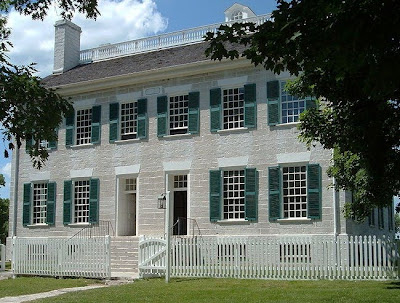
A 19C Shaker Community Restored in Pleasant Hill, Kentucky


Pleasant Hill, Kentucky, was a Shaker religious community from 1805 through 1910. Shakertown, as it is known by the locals, is about 25 miles southwest of Lexington, in the state's bluegrass region.


By 1800, Mother Ann Lee's (1736-1784) religious movement had already established 11 Shaker communities in New York state & throughout New England. About this time, the community sent 3 Shaker missionaries across the Cumberland Gap & through Ohio to find converts in the west. Shakers practiced celibacy & their numbers would die out without new converts.


The Pleasant Hill community was begun by 44 converts who signed a covenant of mutual support & common property ownership of the 140 acres on which they were living. It did not take long for the community to expand & the property to grow to 4,369 acres.


The Shakers chose a peaceful way of life. They were celibate and believed in equality of race & sex and in freedom from prejudice. A quest for simplicity & perfection is reflected in their fine craftsmanship.


The Shakers were skilled farmers, and over the years they expanded land holdings by acquiring adjacent farms for orchards & fields. The Shakers at Pleasant Hill became known for their excellent livestock & engineering accomplishments. Their location near the Ohio River was ideal for agricultural & economic commerce.


By 1816, they regularly traveled to larger communities to sell their wares: brooms, shoes, preserves, garden seeds, & herbs. The Shakers sold their wares in cities and towns up & down the Ohio & the Mississippi rivers, some at great distances, such as New Orleans.


The Shakers, known for their beautifully simple furniture & architecture, also invented many labor-saving processes to serve their large community. In the early 1830s, they constructed a water tower on a high plot of ground. A horse-drawn pump lifted water into the tower, and from there a system of pipes carried it downhill to kitchens, cellars, & wash houses.


In the wash houses, horse-powered washing machines were built to reduce the enormous chore of laundering the community's clothes & linens.


Music was also an important part of Shaker life, with songs, hymns, & anthems written by both men & women. Their dancing or shaking was the origin of the name Shaker.


The community began to decline with the advent of the Civil War & controversies over slave ownership. The last resident on the property died in 1923. The 14 original buildings of the religious community were restored in the 1960s, & it is now the largest restored Shaker community in America, a National Historic Landmark visited by thousands of tourists annually.