.
Norman Rockwell, Rosie the Riviter 1943
The United States Department of Labor tell us that Labor Day, the first Monday in September, is a creation of the labor movement and is dedicated to the social and economic achievements of American workers. It constitutes a yearly national tribute to the contributions workers have made to the strength, prosperity, and well-being of our country.
Founder of Labor Day
More than 100 years after the first Labor Day observance, there is still some doubt as to who first proposed the holiday for workers.
Some records show that Peter J. McGuire, general secretary of the Brotherhood of Carpenters and Joiners and a cofounder of the American Federation of Labor, was first in suggesting a day to honor those "who from rude nature have delved and carved all the grandeur we behold."
But Peter McGuire's place in Labor Day history has not gone unchallenged. Many believe that Matthew Maguire, a machinist, not Peter McGuire, founded the holiday. Recent research seems to support the contention that Matthew Maguire, later the secretary of Local 344 of the International Association of Machinists in Paterson, N.J., proposed the holiday in 1882 while serving as secretary of the Central Labor Union in New York. What is clear is that the Central Labor Union adopted a Labor Day proposal and appointed a committee to plan a demonstration and picnic.
The Moss Industry in the South, Harper's Weekly, September 2, 1882
The First Labor Day
The first Labor Day holiday was celebrated on Tuesday, September 5, 1882, in New York City, in accordance with the plans of the Central Labor Union. The Central Labor Union held its second Labor Day holiday just a year later, on September 5, 1883.
In 1884 the first Monday in September was selected as the holiday, as originally proposed, and the Central Labor Union urged similar organizations in other cities to follow the example of New York and celebrate a "workingmen's holiday" on that date. The idea spread with the growth of labor organizations, and in 1885 Labor Day was celebrated in many industrial centers of the country.
Working Women's Protective Union Hearing Complaint Against Sewing Machine Dealer
Labor Day Legislation
Through the years the nation gave increasing emphasis to Labor Day. The first governmental recognition came through municipal ordinances passed during 1885 and 1886. From them developed the movement to secure state legislation. The first state bill was introduced into the New York legislature, but the first to become law was passed by Oregon on February 21, 1887. During the year four more states — Colorado, Massachusetts, New Jersey, and New York — created the Labor Day holiday by legislative enactment. By the end of the decade Connecticut, Nebraska, and Pennsylvania had followed suit. By 1894, 23 other states had adopted the holiday in honor of workers, and on June 28 of that year, Congress passed an act making the first Monday in September of each year a legal holiday in the District of Columbia and the territories.
A Nationwide Holiday
The form that the observance and celebration of Labor Day should take were outlined in the first proposal of the holiday — a street parade to exhibit to the public "the strength and esprit de corps of the trade and labor organizations" of the community, followed by a festival for the recreation and amusement of the workers and their families. This became the pattern for the celebrations of Labor Day. Speeches by prominent men and women were introduced later, as more emphasis was placed upon the economic and civic significance of the holiday. Still later, by a resolution of the American Federation of Labor convention of 1909, the Sunday preceding Labor Day was adopted as Labor Sunday and dedicated to the spiritual and educational aspects of the labor movement.
Maryland - The Labor Troubles In The Cumberland District - Scenes At and About the Eckhart Mines Detail, Frank Leslie's Illustrated Newspaper, June 10, 1882
Labor Day was important for women who took part in parades and celebrations. It honored women laborers during World War II, who took the place of men in the American workforce, as they were deployed around the world. World War II's Rosie the Riveter was a real woman, Rose Will Monroe, who was born in Pulaski County, Kentucky in 1920, and moved to Michigan during World War II. She worked as a riveter at the Willow Run Aircraft Factory in Ypsilanti, Michigan, building B-29 and B-24 bombers for the U.S. Army Air Forces.
The character of the Labor Day celebration has undergone a change in recent years, especially in large industrial centers where mass displays and huge parades have proved a problem. This change, however, is more a shift in emphasis and medium of expression. Today Labor Day addresses by leading union officials, industrialists, educators, clerics and government officials are given wide coverage in newspapers, radio, and television.
Pennsylvania - The Carpet-Weaver's Strike in Philadelphia - Female Strikers Patrolling the Streets, Frank Leslie's Illustrated News, November 3, 1888
The vital force of labor added materially to the highest standard of living and the greatest production the world has ever known and has brought us closer to the realization of our traditional ideals of economic and political democracy. It is appropriate, therefore, that the nation pay tribute on Labor Day to the creator of so much of the nation's strength, freedom, and leadership — the American worker.
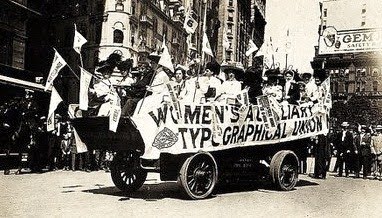
Labor Day Parade, float of Women's Trade Union League, New York
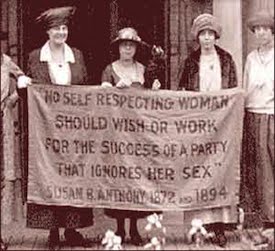
Women Organizing in the 19th Century compiled by the I Am Woman blog.
1824 Women workers strike for the first time in history at Pawtucket, Rhode Island. 102 women workers strike in support of brother weavers protesting the simultaneous reduction in wages and extension of the workday.
1825 'The United Tailoresses of New York' is formed. It is the first union for women only.
Labor Day
1831 In February of this year, almost 1600 women, all members of the United Tailoresses of New York, strike for "a just price for our labor."
1845 The 'Female Labor Reform Association' is formed in Lowell, Massachusetts by Sarah Bagley and other women cotton mill workers to reduce the work day from 12 or 13 hours a day to 10, and to improve sanitation and safety in the mills where they worked.
Detroit, Michigan. Women workers parading in the Labor Day parade photo by Arthur S. Siegel, September 1942 Photos from Farm Security Administration, Office of War Information Collection, Library of Congress
1853 Antoinette Brown becomes the first U.S. woman to be ordained as a Protestant minister.
1867 Cigar makers are the first national union to accept women and African Americans.
1869 In July, women shoemakers form the 'Daughters of St. Crispin', the first national union of women workers, at Lynn, Massachusetts.
World War II Rosies
1872 Congress passes a law giving women federal employee equal pay for equal work.
1881 In Atlanta, Georgia almost 3,000 black women laundry workers stage one of the largest and most effective strikes in the history of the south.
Detroit, Michigan. Float in the Labor Day parade showing relationship between the Army, Red Cross and industrial workers photo by Arthur S. Siegel, September 1942 Photos from Farm Security Administration, Office of War Information Collection, Library of Congress
1888 Suffragists win passage of a law requiring women doctors for women patients in mental institutions.
1889 Jane Adams founds Hull House in Chicago to assist the poor. It becomes a model for many other settlement houses and establishes social work as a profession for women.
Rosies World War II
1892 Mary Kenney O'Sullivan of the Bindery Workers is appointed the AFL's first female national organizer.
1898 Charlotte Perkins Gillman wrote 'Women and Economics' which argues that women need to be economically independent.
1899 The National Consumers League is formed with Florence Kelley as its president. The League organizes women to use their power as consumers to push for better working conditions and protective law for women workers.
Wednesday, March 17, 2021
Monday, March 15, 2021
From the 19C Newspapers - Toenails
.A woman in Minnesota filed for a divorce because her husband “never cuts his toenails and being a restless sleeper, scratches me severely.”
-from The Hartford Weekly Herald, Hartford, Kentucky, April 18, 1894
From Tweets Of Old
-from The Hartford Weekly Herald, Hartford, Kentucky, April 18, 1894
From Tweets Of Old
Saturday, March 13, 2021
19C Men & Women Camping in the Adirondacks, New York
Photographer J F Holley, Camping in Lean-tos in the Adirondacks 1890
Here, both men and women are camping in the Adirondacks in various styles of fashionable dress. The six couples are standing in front of two lean-tos that have been set up as an open camp. One man has a banjo on his knee. The woman at the far left holds a small dog in her arms. Tall trees can be seen beyond the lean-tos.
The lean-tos are furnished with a number of household furnishings like curtains and shelf drapes. A mirror hangs inside the far lean-to. The roofs are covered with overlapping pieces of spruce or pine bark, held down with long boards. The large rocks in front of the lean-to probably mark the fire pit for campfires.
The photo shows many details of clothing and accessories. The women are wearing long skirts and fitted blouses. The men are wearing high, thick socks and breeches, fitted pants that end at the knee. Shoes, belts, jewelry and hats can also be seen. Three of the men are wearing a Scottish style of hat called a Tam o' Shanter.
J. F. Holley was a photographer from Chestertown, NY, during the late nineteenth century. He photographed Adirondack locations and people in the 1870s-90s, and published a series of photographs he called Adirondack Views. He also operated a variety store, and repaired bicycles, clocks, jewelry, etc.
Thursday, March 11, 2021
19C Long Island in the 1860-70s by William Moore Davis (1829–1920)
.
William Moore Davis (American artist, 1829–1920) The Lady Behind the Door
Born in Setauket, New York, the self-taught William Davis was a painter of trompe l'oeil still life, genre, & landscapes. He trained as a boat builder in Port Jefferson, Long Island. There, he befriended renowned genre painter William Sidney Mount, who lived nearby in Stony Brook. Davis was influenced by Mount, who was one of the most respected painters in America at that time. Although Davis was never a pupil of Mount's, surviving letters between the two artists show that Mount often gave the younger painter artistic advice.
William Moore Davis (American artist, 1829–1920) A Close Shave
In 1868, Davis exhibited still-life paintings at the National Academy of Design. From 1863-1871, he exhibited at the Brooklyn Art Association. Davis had opened a studio in New York City in 1868; but in 1872, he returned permanently to the Long Island area of Port Jefferson, where he was affectionately known as "Painter Davis." Mount had died 4 years earlier, & to a degree, Davis continued in his mentor's footsteps, providing locals with paintings of villagers pursuing their daily tasks, the area's quiet bays & coves, as well as boats anchored or at sea.
William Moore Davis (American artist, 1829–1920) Girl Reading by a Tree c 1875
Once he returned to Long Island, Davis exhibited exclusively in Port Jefferson, with the exception of a one-man show in Bridgeport, Connecticut in 1894. According to the Bridgeport Daily Standard, Davis showed 135 of his works and had over 700 people in attendance. Davis died on Long Island in 1920.
William Moore Davis (American artist, 1829–1920) Cider Making on Long Island
William Moore Davis (American artist, 1829–1920) Farmyard
Tuesday, March 9, 2021
From the 19C Newspapers - Giddy Mother of 16
Mrs. J.C. Anderson, a giddy young thing, and the mother of 16 children, has run away with a big-trousered dude 25 years of age.
Xenia, Ohio 1889 -The Telegraph
From Tweets Of Old
Sunday, March 7, 2021
From the 19C Newspapers - The Bustle Returns
What self-respecting female sticks a hump on her back the size of a dollar’s worth of flour?
The Winston Herald, March 15, 1894 (Alabama)
That Pesky Bustle.—That ridiculous bustle is going to be “the fashion” again this summer. What self-respecting female sticks a hump on her back the size of a dollar’s worth of flour? It seems to a man up a tree like it’s time to call a halt and consider the bearings. We truly hope that the pretty girls of Winston will refrain from making themselves ridiculous by wearing the bustle this summer. We don’t care a snap what the ugly girls do about it.
From Tweets Of Old
Saturday, March 6, 2021
American Folk Art - Quaint Portraits of Early 19C American Women
attributed to John Usher Parsons (American artist, 1806-1874) Woman in Pink c 1835-38
Several New England artists shared a unique painting style during the 1820s-30s. Women depicted by these artists exhibit several similar characteristics - pale, sculptural faces; prominent thin, delicately arched eyebrows; small bowed mouths; & elaborate classical Greek hairstyles of tight curls intertwined with jewelry, flowers, & other adornments. The paintings are usually watercolors. The artists paint strong features, sharply defined, with arched, curved eyebrows. The watercolors are similar to fashion plates appearing in magazines such as Ackerman’s Repository of Arts, Literature, Commerce, Manufactures, Fashions & Politics, published in London in 1809 through 1829.
attributed to John Usher Parsons (American artist, 1806-1874) Porcupina Van Allen
Parsons received his early education at Latin schools in Parsonsfield, Maine, where he was born, and in nearby Effingham, New Hampshire. Parsons graduated from Bowdoin College in Brunswick, Maine. He was ordained in New York City in 1831, & became a preacher traveling to Indiana, Wisconsin, & Kansas. A dozen or so paintings by Parsons date to the period just after his return to the East Coast. Most are of subjects who lived in the area around Parsonsfield & in New Bedford, Massachusetts, where Parsons was minister for several years. The works appear to have been executed during a four-year span from 1834 to 1838.
Friday, March 5, 2021
From the 19C Newspapers - Chicken Bones
New York, Nov. 16, 1899–
Justice Bookstaver, in the Supreme Court, yesterday heard the application for divorce made by Mrs. Mary E. Okerlind from Gustavus E. Okerlind of Brooklyn. Mrs. Okerlind testified that when they used to have chicken for dinner Mr. Okerlind would pick up his chicken bones and dance them upon the table, so she could see how she would look as a skeleton. He would say to her upon such occasions that they had been married nine years and that it was time she died, as no wife should live longer.Mr. Okerlind testified that his wife has always treated him harshly and threatened him with bodily harm. Once she threw a pail of water on him when he was in the garden. Justice Bookstaver reserved decision.
-The New Haven Evening Register
From Tweets Of Old
Wednesday, March 3, 2021
Earliest known portrait of practicing American Muslim by Charles Willson Peale
.
One of the earliest formal portraits of an African American - a well-known oil painting of a kufi-wearing free black man painted by Charles Willson Peale in 1819 - has been sold by the Philadelphia History Museum at the Atwater Kent to the Philadelphia Museum of Art.
Charles Willson Peale (American painter, 1741-1827). Yarrow Mamout is believed to be the earliest known portrait of a practicing American Muslim.
In 1819, Charles Willson Peale headed down to Washington DC to paint portraits of President James Monroe, Henry Clay, and other dignitaries for exhibition in the famed Peale museum located in Independence Hall.
But there was another sitter the painter wanted to snare on his trip.
"I heard of a Negro who is living in Georgetown said to be 140 years of age," Peale wrote in his diary. "He is comfortable in his Situation having Bank stock and lives in his own house."
The man was Yarrow Mamout, a free African, a Muslim who indeed held bank stock, purchased with great effort to secure a comfortable old age - after a life of abduction and bondage. (He was, however, most likely only in his 80s.)
Mamout, known throughout Georgetown as affable and chatty, sat for Peale for at least two days, talking about his life.
The finished portrait - the earliest known rendering of an American Muslim and an extremely rare early portrayal of a free African - has been purchased by the Philadelphia Museum of Art from the Philadelphia History Museum at the Atwater Kent. It is already on view at the Art Museum.
"It's such a wonderful picture," said Kathleen A. Foster, the museum's senior curator of American art. "It's been cleaned. He looks so great, so great. It just sparkles."
She continued: "We're never going to take that painting down. It will be out seven days a week. It's such a great story."
Mamout told at least some of that story to Peale (who was 78 years old at the time), fascinating the painter and inspiring him to fill his diary with Yarrow Mamout anecdotes.
Mamout had been born in West Africa (probably Guinea), captured by slave traders, and shipped to America when a teenager in the early 1750s.
Once here, he was purchased by Samuel Beall of Maryland and passed on to his son, Brooke Beall.
Brooke Beall told Mamout sometime in the 1790s that if he helped build the Beall home in Georgetown, he would be freed when it was completed.
Although Brooke died before the house was done, his widow kept the promise, freeing Yarrow Mamout.
Peale was so intrigued by this story that he visited the widow, who confirmed it.
After he was freed, Mamout went on to work tirelessly as a laborer, saving money, losing it, saving more, and eventually acquiring some measure of security as one of Washington's few free blacks in the early 19th century.
"Yarrow owns a house & lotts and is known by most of the Inhabitants of Georgetown & particularly by the Boys who are often teazing him which he takes in good humour," Peale confided in his diary. "The acquaintance of him often banter him about eating Bacon and drinking Whiskey - but Yarrow says it is no good to eat Hog - & drink whiskey is very bad."
After completing the portrait, Peale brought it back to Philadelphia and hung it in his museum, perhaps as a complement to the portrait of Absalom Jones - noted clergyman and cofounder of Philadelphia's Free African Society and leader of the African Episcopal Church of St. Thomas - painted by Raphaelle Peale, Charles' son.
Exhibited with Peale renderings of the nation's eminent statesmen, including George Washington, Thomas Jefferson, and Benjamin Franklin, Yarrow Mamout was a magnet for visitors.
In 1854, long after Peale's death, his museum's holdings were liquidated, and Yarrow Mamout was purchased by a prominent Philadelphia Quaker and businessman, Charles S. Ogden. Ogden also purchased the Peale portrait of Washington painted at Mount Vernon in 1772, believed to be the first portrait of the future general and president.
Ogden apparently thought the two paintings were closely related because when he donated both to the Historical Society of Pennsylvania in 1892, he included a letter misidentifying Yarrow Mamout as Billy Lee, "Washington's favorite military servant during the war for Independence."
Lee was the only slave Washington freed immediately in his will.
Over the next century, Yarrow Mamout - who was not correctly identified until the 1940s - was often on exhibit at the historical society until 2001, when its ownership was transferred, along with virtually all of the 10,000 historical society artworks and artifacts, to the Atwater Kent.
The Kent showed the painting at least once, in 2004, in commemoration of Martin Luther King's Birthday and African American History Month.
Mayor Nutter hailed the art museum's acquisition in a statement Thursday evening:
"This portrait depicts a man who triumphed over enormous challenges and commanded the respect and admiration of all who knew him. It is a great thing that such an extraordinary painting will remain here so that it can continue to serve as an inspiration for all of our citizens."
Foster, of the Art Museum, said the painting represented a renaissance of Peale's artistic powers.
"Peale, age 77, 78, was so on his game," she said. "The whole thing, these two old men, are a testimony to the power of age."
And, she added, "What a story!"
Philadelphia Inquirer - Stephan Salisbury - October, 23, 2011
.
Tuesday, March 2, 2021
American Folk Art - Women & Their Children Attributed to George G. Hartwell 1815-1901
George G. Hartwell (American artist, 1815-1901) Prior-Hamblen School attributedChild Holding Doll and Shoe c 1845
George G. Hartwell was associated with the Prior-Hamblin group of painters. He was related to William Matthew Prior by marriage and he painted signs and portraits in Bridgewater, Massachusetts and Auburn, Maine. His flat style of painting is very close to that of William Matthew Prior, Sturtevant Hamblin, George Bailey Moore, and G. Alden. These paintings are attributed to him, because he did not sign his work.
George G. Hartwell (American artist, 1815-1901) Prior-Hamblen School attributed Young Woman in Grey Dress with Rose c 1840
George G. Hartwell (American artist, 1815-1901) Prior-Hamblen School attributed Young Boy in Grey
George G. Hartwell (American artist, 1815-1901) Prior-Hamblen School attributed Unknown Woman, probably New England, ca. 1840.
George G. Hartwell (American artist, 1815-1901) Prior-Hamblen School attributed Ann Maria Wilcox Holding a Rose
George G. Hartwell (American artist, 1815-1901) Prior-Hamblen School attributed Young Woman
George G. Hartwell (American artist, 1815-1901) Prior-Hamblen School attributed Girl with Rose
George G. Hartwell (American artist, 1815-1901) Prior-Hamblen School attributed Woman holding Red Book
George G. Hartwell (American artist, 1815-1901) Prior-Hamblen School attributed Child in Red Dress
George G. Hartwell (American artist, 1815-1901) Prior-Hamblen School attributed Woman in Blue Dress
George G. Hartwell (American artist, 1815-1901) Prior-Hamblen School attributed Boy in Scroll-Back Chair
George G. Hartwell (American artist, 1815-1901) Prior-Hamblen School attributed Mary Williams (Mrs. John Williams)
George G. Hartwell (American artist, 1815-1901) Prior-Hamblen School attributed Albert Winslow Trow
George G. Hartwell (American artist, 1815-1901) Prior-Hamblen School attributed Woman Holding a Rose
George G. Hartwell (American artist, 1815-1901) Prior-Hamblen School attributed Girl in Pink Dress
George G. Hartwell (American artist, 1815-1901) Prior-Hamblen School attributed Girl in Blue Dress
Monday, March 1, 2021
Another Portrait of African American Muslim Yarrow Mamout 1822
.
1822 James Alexander Simpson (American artist & teacher) Yarrow Mount. Peabody Room, Georgetown Public Library
Georgetown artist James Alexander Simpson, a sometime painter & instructor at Georgetown College, painted this portrait of Yarrow Mamout in 1822. The Simpson portrait appears to have been painted from life & is not a copy of the much better known 1819 portrait (done when Mamout was about 83 years old) by the celebrated American painter, Charles Willson Peale. The Simpson painting was probably done in 1822 (the date on the label next to the painting), about two years before Yarrow's death.
Yarrow Mamout was born in Africa around 1736 and was a teenager when enslaved & brought to America, apparently no later than 1752. Yarrow (Mamout was his first name) was born & educated in Guinea, West Africa. Recent research shows that Yarrow probably was of Fulani heritage (in which the name Yaro still is used) & was literate in Arabic.
At about age 14 he was captured by slave traders & shipped to the United States, where Samuel Beall of Maryland purchased him. Beall bequeathed Yarrow to his son, Brooke Beall, who had Yarrow make bricks for a house he was building in Georgetown. After Brooke Beall's death his widow freed Yarrow in 1796. Yarrow saved the money he earned as a laborer & after 4 years was able to purchase a house & other property in Georgetown.
According to James H. Johnston’s 2006 Washington Post article, Yarrow himself was a survivor, having amassed a hundred-dollar nest egg for his retirement. Twice, merchants who held the money for him lost it when their businesses failed. Yarrow scraped & saved a third time, putting aside two hundred dollars, which he used to buy shares in Georgetown’s Columbia Bank, finally allowing him to support himself in retirement with the interest from his investment.
Yarrow, who followed the Muslim faith at a time when few Americans did, was immortalized by these two white artists near the end of his life. Yarrow reportedly was buried in his yard; research is ongoing into whether his remains are still there & whether any part of the house at 3324, 3330-3332, Dent Place NW in Georgetown could have been Yarrow's.
Sources:
Valerie Babb, Carroll Gibbs, & Kathleen Lesko, Black Georgetown Remembered (Washington: Georgetown University Press, 1991), 11-12.
Thomas J. Carrier, Historic Georgetown: A Walking Tour, Images of America Series (Charleston, SC: Arcadia, 1999).
Kenneth C. Haley, “A Nineteenth Century Portraitist & More: James Alexander Simpson,” Maryland Historical Magazine 72-3 (fall 1977): 410-411.
Yarrow Mamout, Vertical Files, Peabody Room, Georgetown Public Library
James H. Johnston, "The Man in the Knit Cap," Washington Post Magazine, Feb. 5, 2006.
Humanities Magazine, November/December 2008 Volume 29, Number 6
.
Saturday, February 27, 2021
From the 19C Newspapers - A Curious Case of Kidnapping in June 1857
.
Unknown American Artist Baby in a Red Chair 1825
A German girl named Bertha Bushkill, “was arrested on Sunday last, in New York, for kidnapping a child. Her purpose was that she might induce a young man who had been courting her to marry her.
She had told him that he was the father of a child which she pretended was being taken care of by some of her friends.
Her lover consented to marry her, provided she would produce the child. She accordingly, stole a child; took it home, and her lover being pleased with the appearance of the child agreed to fulfill his part of the contract.
Preparations were going forward for the marriage at the time of the arrest.”
From the Semi-Weekly Western Sun, June 30, 1857
Thursday, February 25, 2021
From the 19C Newspapers - Old Fogies
.
Mrs. W. H. Clausen gave birth to a healthy son weighing fifteen pounds. And yet old fogies croak about the degeneration of the human race.
-from the Burlington Hawkeye, Des Moines, Iowa, March 19, 1874
From Tweets of Old
Mrs. W. H. Clausen gave birth to a healthy son weighing fifteen pounds. And yet old fogies croak about the degeneration of the human race.
-from the Burlington Hawkeye, Des Moines, Iowa, March 19, 1874
From Tweets of Old
Wednesday, February 24, 2021
Life in North Carolina during Reconstruction
WOMAN WITH COLLARD LEAF ON HER HEAD TO CURE A HEADACHE by Mary Lyde Hicks William (1866-1959) Mary reflected daily life she saw on her uncle's plantation during Reconstruction in North Carolina.
Tuesday, February 23, 2021
19C American Women - Allen Smith Jr (1810–1890)
.
Allen Smith Jr (American artist, 1810–1890) The Artist's Mother
New York-trained artist, Allen Smith, Jr. settled in Cleveland, Ohio in 1841, having been in New York City from 1930, and swiftly rose to prominence there as a portrait & genre painter.
Allen Smith Jr (American artist, 1810–1890) The Young Mechanic
Like all artists, Smith suffered greatly during the Panic of 1857, forcing him to take a job in James F. Ryder’s studio where, according to his employer’s advertisements, he produced the “best oil painted photographs in Ohio.”
Allen Smith Jr (American artist, 1810–1890) A Lady
With 8 children to support, Smith collaborated with other photographers in times of need, both in Cleveland & Cincinnati, but ended his days happily in Ohio's Lake County, painting landscapes in the Big Creek Valley.
.
Monday, February 22, 2021
American Folk Art - Unconventional Portrait of an Early 19C American Woman
Unknown Vermont Artist. Woman in a Rose Dress c 1805-1815
Several New England artists shared a unique painting style during the 1820s-30s. Women depicted by these artists exhibit several similar characteristics - pale, sculptural faces; prominent thin, delicately arched eyebrows; small bowed mouths; & elaborate classical Greek hairstyles of tight curls intertwined with jewelry, flowers, & other adornments. The paintings are usually watercolors. The artists paint strong features, sharply defined, with arched, curved eyebrows. The watercolors are similar to fashion plates appearing in magazines such as Ackerman’s Repository of Arts, Literature, Commerce, Manufactures, Fashions & Politics, published in London in 1809 through 1829.
Subscribe to:
Posts (Atom)


+Porcupina+Van+Allen.jpg)


